
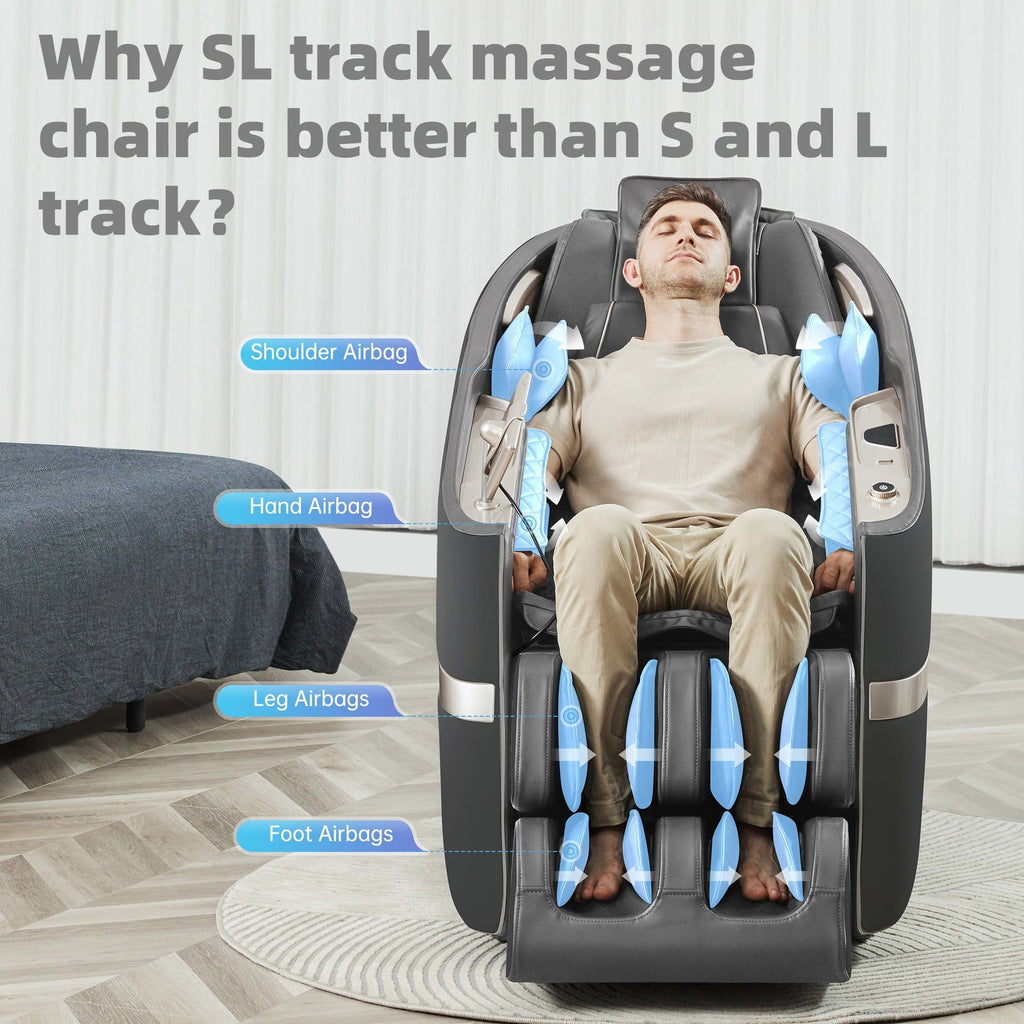
An s track massage chair uses a massage rail that follows the natural curve of the spine instead of moving in a mostly straight vertical line. The design is intended to keep the rollers closer to the body from the neck and shoulders through the mid-back and lumbar area, which can make the massage feel more consistent across those regions.
That does not mean every S-track chair provides the same coverage or comfort. Roller travel, chair shape, body scanning, massage mechanism, and the user’s height all affect the result. The S-shaped rail is an important design feature, but it is only one part of the overall massage experience.
Understanding where an S-track works well—and where it has limits—makes it easier to compare massage chairs without relying on marketing terms alone.
What an S-Track Massage Chair Is
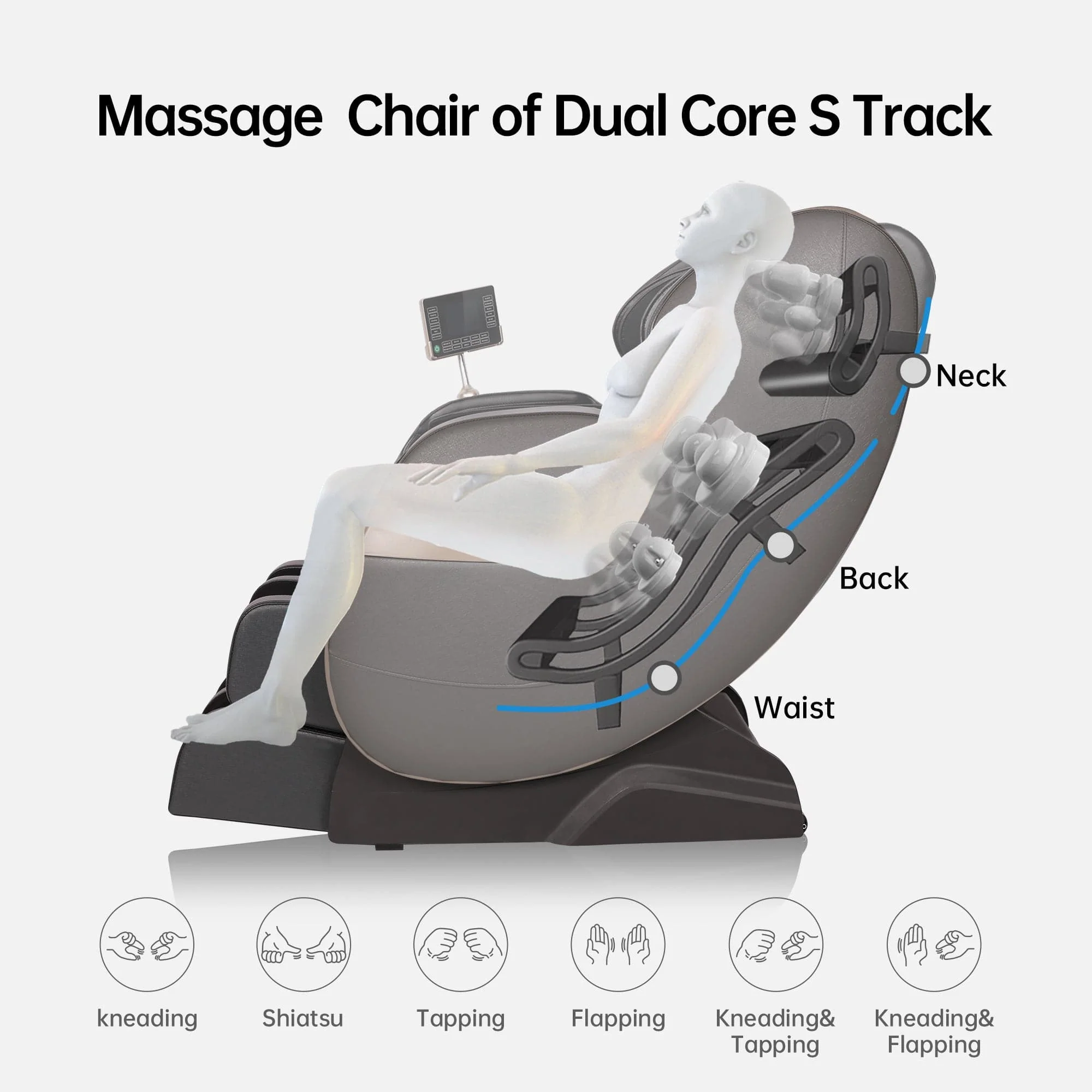
An S-track is a curved massage track installed inside the chair’s backrest. It is shaped to follow the typical profile of the human spine: inward at the neck, outward through the upper and mid-back, then inward again near the lower back.
The rollers travel along this curved path while performing massage movements such as kneading, tapping, rolling, shiatsu-style motions, or combinations of those techniques. Depending on the chair, the rollers may work in fixed locations, move continuously along the track, or follow an automatic massage program.
The purpose of an S-track is not to change the massage technique itself. Instead, it changes how the roller mechanism is positioned relative to the user’s back. A well-designed curved rail can help rollers maintain closer contact around the lumbar curve than a flatter track may provide.
Why the shape matters
The back is not flat. If rollers travel on a straight path while the backrest and body curve away from them, the pressure may feel uneven. Some areas may receive strong contact while others feel lighter.
By following the spine’s general contour, an S-track can help create a more connected massage through these areas:
- Neck and upper shoulders: where users often want focused kneading or tapping.
- Upper back: including the region around the shoulder blades.
- Mid-back: where roller contact can vary depending on body shape.
- Lumbar area: where the inward curve of the lower back can otherwise reduce roller pressure.
However, “spine-following” should be understood as a general design approach, not a guarantee that the chair will fit every spine precisely. Bodies vary significantly in height, shoulder width, back shape, and sensitivity to pressure.
How S-Track Coverage Usually Works
Most S-track massage chairs concentrate their roller massage from the upper neck or shoulder region to the lower back. The exact start and end points vary by model, and manufacturers may describe coverage in different ways. A longer rail does not automatically mean more useful coverage if the rollers do not align well with the user’s body.
In practical terms, S-track coverage is usually strongest through the back rather than the glutes, hamstrings, or calves. Many chairs extend their total-body massage using separate systems, including airbags, vibration, foot rollers, calf massage chambers, and seat mechanisms.
Back coverage versus whole-body coverage
It is easy to confuse roller-track length with overall massage coverage. The track describes the path of the back rollers. It does not necessarily indicate what happens below the lower back.
| Area | How an S-track may contribute | What usually provides massage beyond the track |
|---|---|---|
| Neck and shoulders | Rollers may reach the upper back and shoulder line, depending on chair design and body scan. | Shoulder airbags or fixed neck pads on some models. |
| Mid-back | The curved rail helps rollers travel along the upper and middle spinal contour. | Roller width adjustment and massage programs. |
| Lower back | The lower curve of the rail can help maintain roller contact around the lumbar region. | Heat pads, airbags, or targeted lumbar settings where included. |
| Glutes and upper thighs | Usually limited, depending on where the track ends. | Seat airbags, vibration, or a seat massage plate. |
| Legs and feet | No direct roller-track coverage. | Calf compression, foot rollers, and foot airbags. |
For this reason, a buyer seeking strong lower-body massage should look beyond the S-track label. Check how the chair treats the seat, calves, ankles, and soles of the feet.
Body scanning affects usable coverage
Many massage chairs use a body scan at the beginning of a session. This feature attempts to identify shoulder position, back length, and key areas along the back so the roller range can be adjusted. Some chairs also allow manual shoulder-position changes after the scan.
A body scan can improve the experience, particularly in households with users of different heights. Still, it is not perfect. If the scan places the rollers too high, too low, or too wide, the massage may miss the intended areas. Manual adjustment is especially valuable for users who want the rollers to work closer to the neck, between the shoulder blades, or near the lower back.
What an S-Track Feels Like in Use
The main benefit many people notice with an S-track massage chair is more continuous roller contact along the back. Rather than feeling as though the rollers move away from the lower back, the massage can stay closer to the body as it follows the chair’s curved path.
That said, the sensation depends on more than the rail. A gentle roller mechanism on a well-shaped S-track may still feel mild. A powerful mechanism with narrow rollers can feel intense even if the chair has excellent body contouring.
Credit: massagechairdeals.com
Factors that shape the massage sensation
- Roller mechanism: A chair’s roller design influences the range and depth of motions it can perform.
- Intensity controls: Adjustable intensity is useful because one person’s comfortable pressure may feel too strong to another.
- Roller width: Width settings can affect whether the massage reaches the muscles near the spine and shoulder blades comfortably.
- Padding and upholstery: Thick padding can soften roller pressure, while thinner padding may make techniques feel more direct.
- Recline position: Reclining changes weight distribution and can alter how firmly the body rests against the rollers.
- User build: A narrow, broad, tall, short, light, or heavier user may experience the same chair differently.
For relaxation, a chair with several intensity levels and an easy way to adjust the roller position is often more practical than one that simply advertises a long track or numerous automated programs.
S-Track Versus L-Track Massage Chairs
The most common comparison is between an S-track and an L-track. Both begin with a spinal contour through the upper and lower back. The difference is what happens after the rollers reach the lumbar region.
An L-track typically continues farther down the chair, extending beneath the seat toward the glutes and sometimes the upper hamstrings. Its rail resembles an “L” when viewed from the side: an S-shaped back section followed by a longer, more horizontal lower section.
| Feature | S-Track | L-Track |
|---|---|---|
| Primary roller path | Follows the back’s natural curves from upper back to lower back. | Follows the back, then continues under the seat toward the glutes or upper thighs. |
| Back-focused massage | Usually the central purpose of the design. | Also provides back massage, with added lower-body roller reach. |
| Glute massage | Often relies on airbags, vibration, or seat features rather than traveling rollers. | May use the main roller mechanism for more direct glute coverage. |
| Chair design priorities | Can suit buyers focused mainly on neck-to-lumbar massage. | Can suit buyers who want roller coverage beyond the lower back. |
| Potential trade-off | Less direct roller massage below the lumbar area. | May cost more or feel less appealing to users who do not enjoy seat-level roller pressure. |
Which track is better?
Neither is universally better. An S-track can be the sensible choice for someone whose priority is back massage, especially around the shoulders and lumbar area. An L-track may be more appealing for someone who wants the rollers to continue into the glute region rather than relying mainly on airbags or vibration there.
Comfort should decide the comparison. Some people enjoy extended lower-body roller travel, while others find it too intense or simply do not need it. A higher-quality S-track chair can be more satisfying than an L-track chair with poor fit, limited adjustment, or uncomfortable programming.
Benefits of an S-Track Design
S-track massage chairs remain common because the design addresses a practical problem: maintaining contact as the back changes shape from the shoulders to the lumbar region. When the chair fits the user well, this can produce several meaningful advantages.
More natural contact through the lower back
The inward curve near the lumbar spine is one of the most important areas for track design. An S-track is intended to bring the roller path into that curve, rather than leaving a gap between the rollers and lower back. This can make rolling and kneading feel more even from the mid-back down to the lumbar area.
Useful for back-centered massage routines
People who primarily use a massage chair for upper-back, shoulder, and lower-back relaxation may not need a longer rail. An S-track keeps the focus on these areas and is often paired with targeted programs for stretching, gentle rolling, kneading, or tapping.
Works well with air compression systems
Rollers are only one type of massage component. Shoulder, arm, hip, calf, and foot airbags can add compression-based massage around the body while the S-track works along the back. In a balanced chair design, these features can provide broad comfort coverage without requiring the main rollers to travel below the seat.
Can support a compact feature set
Track style alone does not determine chair size, but an S-track chair may suit buyers who do not specifically need extended roller travel under the seat. The practical space requirement still depends on the chair’s overall dimensions, recline path, footrest extension, and clearance from the wall.
Trade-Offs and Limitations to Consider
An S-track is a design feature, not a guarantee of a superior massage chair. Before choosing one, consider the limitations that may matter for your body, space, and preferred massage style.
Credit: sltrackmassagechair.com
Limited main-roller reach below the lower back
The clearest trade-off is lower-body roller coverage. If you want the sensation of rollers moving through the glutes or upper hamstrings, an S-track may not provide it. Seat airbags can create squeezing pressure, and vibration may add sensation, but neither necessarily feels like traveling rollers.
Fit is still highly individual
An S-shaped rail follows a general spinal profile, not your exact anatomy. Taller users may find the upper roller limit too low. Shorter users may feel the shoulder position is too high. Broad-shouldered users may need generous roller-width adjustment, while narrower users may prefer a chair that can bring the massage closer toward the spine.
Check the manufacturer’s stated height guidance if available, but treat it as a starting point rather than a promise. A chair’s headrest, seat depth, shoulder pads, and scanning system can all change the real fit.
Strong lumbar contact is not always comfortable
For some users, the benefit of an S-track—closer lumbar contact—can also be a drawback. Firm rollers working into the lower-back curve may feel too intense, especially at higher settings or through thin upholstery.
Look for multiple intensity levels, manual roller positioning, and the ability to choose gentler techniques. If possible, trying a chair in person is useful. If that is not practical, review the return policy carefully before buying.
Track terminology can hide more important differences
Manufacturers often feature track type prominently because it is easy to explain. Yet several other details may have a larger effect on daily satisfaction:
- How easily the chair fits the user’s height and shoulder position
- Whether intensity can be reduced enough for comfortable regular use
- The quality and variety of roller movements
- Whether the footrest accommodates the user’s leg length
- How much space the chair needs in both upright and reclined positions
- Control usability, including remote layout and manual adjustment options
- Noise level, upholstery care needs, and access for service or maintenance
How to Evaluate an S-Track Massage Chair Before Buying
Rather than choosing based on the track alone, assess the complete system. The best chair is one whose roller path, body fit, controls, and massage style match how you plan to use it.
Start with body fit
Look at the seat width, seat depth, shoulder area, headrest position, and footrest range. If more than one person will use the chair, a dependable body scan and manual adjustment options become more important.
Pay attention to whether the chair’s shoulder massage components feel restrictive. A chair can have an effective S-track but still feel uncomfortable if shoulder airbags or padding push the body into an awkward position.
Check roller control, not just automatic programs
Automatic programs are convenient, but manual controls provide more lasting value. Useful options may include:
- Changing massage intensity
- Selecting a specific technique, such as kneading or tapping
- Adjusting roller width where supported
- Moving the rollers to a chosen spot on the back
- Selecting full-back, partial-back, or point-focused massage
- Setting a comfortable session duration
These controls help the chair adapt to different preferences without implying that it can diagnose or treat pain. A massage chair may support relaxation and temporary comfort for some users, but persistent, severe, or unexplained back symptoms should be discussed with a qualified healthcare professional.
Measure the room and recline clearance
Massage chairs are larger than standard armchairs, particularly when the leg rest extends. Measure the available floor space, doorway width, hallways, and turns required for delivery. Also confirm the clearance needed behind the chair when it reclines.
Some chairs are designed to recline closer to a wall than others, but this feature varies by model. Do not assume a chair will fit a tight room simply because it has an S-track.
Consider maintenance and long-term practicality
Massage chairs contain moving mechanisms, upholstery, electrical components, and often air compression systems. Place the chair on a stable, level surface, keep it away from excess moisture, and follow the manufacturer’s cleaning and maintenance instructions.
Before purchase, it is also wise to check warranty terms, service availability in your area, and whether the chair can be moved or repaired if necessary. A complicated chair with many features may be appealing, but support and parts access matter over time.
Who an S-Track Chair Usually Suits
An S-track chair is often a good fit for buyers who want concentrated massage from the neck and shoulders through the lower back. It can be especially appealing when the goal is a back-focused relaxation routine rather than extended roller massage into the glutes and thighs.
It may suit you if you value:
- A roller path designed around the changing curve of the back
- Consistent attention to the mid-back and lumbar area
- Adjustable back massage without needing under-seat roller travel
- A chair that combines back rollers with airbags for arms, legs, or calves
- Targeted manual massage controls for preferred back areas
An L-track or another design may be a better match if deep glute massage is a top priority. Likewise, a person who wants only light, occasional comfort may be better served by a chair with gentle controls and good body fit rather than the most extensive track available.
Credit: amazon.com
Frequently Asked Questions
Does an S-track massage chair massage the neck?
Many models can reach the upper back, neck base, and shoulder area, but the exact range depends on the chair’s roller design and body scan. The rollers may not reach the same spot for every user, particularly if the chair does not fit their height well. Adjustable shoulder position and a movable pillow can help fine-tune comfort.
Can an S-track chair massage the hips?
An S-track’s main rollers usually stop around the lower-back region, so hip massage often comes from airbags or seat features rather than the roller mechanism. Chairs with extended tracks may provide more direct roller travel around the glutes and upper thigh area.
Are S-track massage chairs suitable for tall people?
Some are, but suitability depends on the model’s stated user-height range, shoulder detection, backrest shape, and footrest extension. Tall users should pay particular attention to upper roller reach and legroom. A body scan helps, but it cannot overcome a chair frame that is too short for the user.
Do S-track chairs require special maintenance?
No special maintenance is required solely because of the S-track, but the chair should be cleaned and used according to its manual. Keep the upholstery clean, avoid blocking moving parts, inspect the power cord periodically, and arrange professional service if the chair develops unusual noises, movement problems, or electrical issues.
Is an S-track massage chair safe to use every day?
For many people, moderate use within the manufacturer’s instructions can be part of a regular relaxation routine. Start with lower intensity and shorter sessions to judge comfort. People who are pregnant, have implanted medical devices, recent injuries, circulation concerns, or ongoing medical conditions should seek advice from an appropriate healthcare professional before use.