
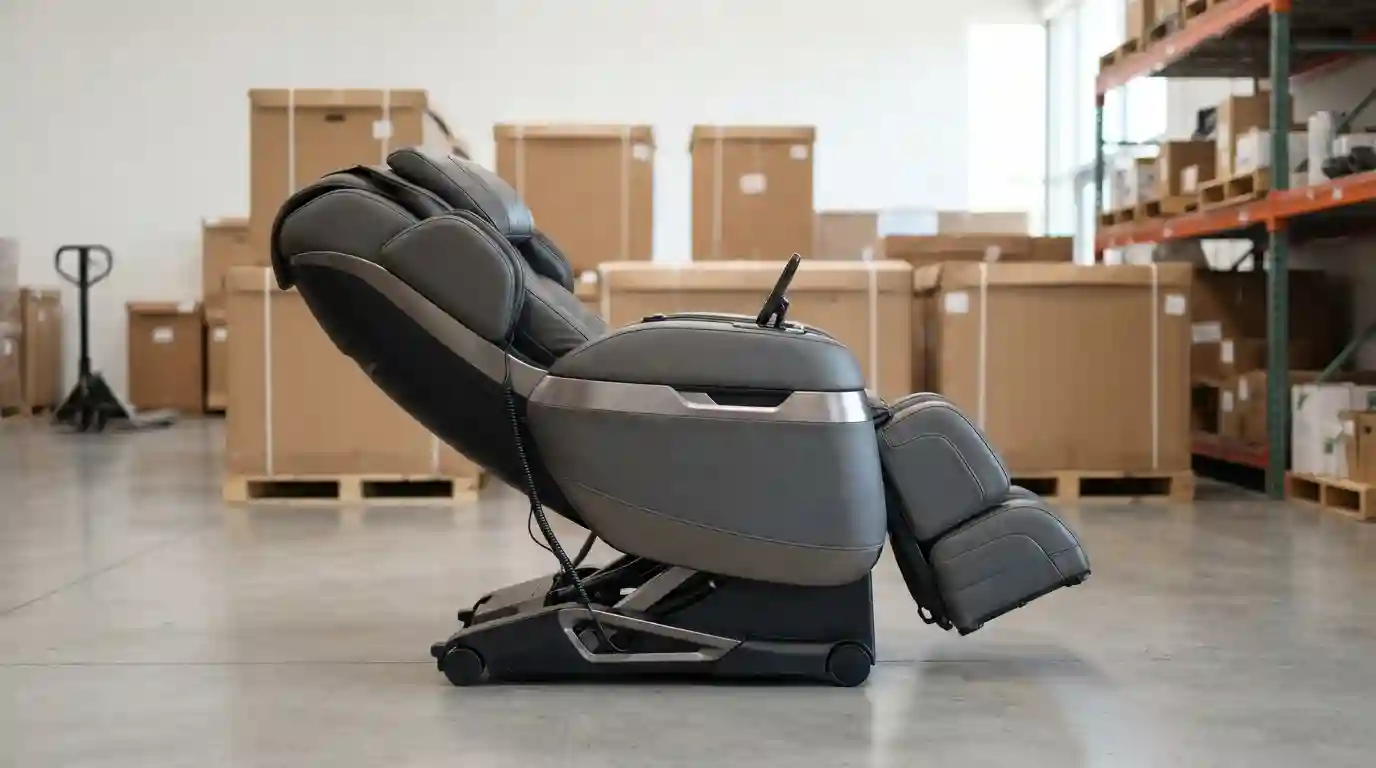
For buyers asking where are Osaki massage chairs made, the practical answer is that most Osaki massage chairs sold in North America are manufactured in China. Osaki is a consumer-facing massage chair brand, while production is generally handled through overseas manufacturing partners and factories rather than a U.S.-based chair factory.
That does not mean every chair with the Osaki name is identical in origin, engineering, or component sourcing. Massage chairs are complex products assembled from motors, roller systems, airbags, electronics, upholstery, frames, and control components that may come from more than one supplier. The country shown on a specific model’s label, carton, manual, or product compliance documentation is the best source for confirming its origin.
For most shoppers, manufacturing location is only one part of the decision. Build quality, warranty support, repair access, fit, massage mechanism, and the reliability of the seller often matter more than whether a chair is branded in the United States or assembled overseas.
Osaki Massage Chairs Are Generally Made in China
Osaki massage chairs are generally manufactured in China, where much of the global massage chair industry is based. China has a large manufacturing network for massage chair frames, motors, air compression systems, circuit boards, synthetic upholstery, remote controls, and other specialized components.
Osaki is widely marketed in the United States and Canada through authorized dealers, online retailers, and specialty massage chair stores. However, a U.S. sales presence, U.S. customer service operation, or domestic warehouse does not mean that the chair itself was made in the United States.
If you are wondering, “where is Osaki massage chair made?” it is helpful to separate the brand’s commercial presence from the physical manufacturing process:
- Branding and market support: The Osaki name is marketed to North American buyers, with dealer networks, warranty programs, product information, and customer support serving that market.
- Manufacturing and assembly: Most models are produced in China through established massage chair manufacturing operations.
- Components: Individual parts can be sourced from multiple suppliers and may not all originate in the same country as final assembly.
- Distribution: Chairs may be imported, stored in U.S. warehouses, and shipped domestically to customers after purchase.
Because product lineups change, it is best not to treat country of origin as a permanent specification for every past, present, and future Osaki model. Check the information attached to the exact chair you are considering.
Why So Many Massage Chairs Are Manufactured in China
China is not an unusual manufacturing location for massage chairs. It is one of the main global production centers for this category, including chairs sold under a wide range of brands at entry-level, mid-range, and premium price points.
A full-featured massage chair requires a specialized supply chain. It is not simply an upholstered recliner with a vibration pad. Depending on the model, it can include a moving roller track, geared motors, airbags, valves, pumps, heating elements, body-detection sensors, powered recline mechanisms, speakers, control boards, and remote-control hardware. Manufacturers located near component suppliers can source and assemble those systems more efficiently.
Manufacturing location is not a quality grade
“Made in China” does not, by itself, tell you whether a massage chair is well built or poorly built. Manufacturing quality depends on the factory’s standards, quality-control procedures, component selection, product design, inspection process, and the brand’s support after the sale.
Two chairs assembled in the same country can differ substantially in their roller feel, motor noise, upholstery durability, fit and finish, software controls, serviceability, and expected long-term ownership experience. The same is true of chairs made in any manufacturing region.
Instead of using origin as a shortcut for quality, use it as one fact in a broader evaluation. A buyer should still ask who will provide parts, how warranty claims are handled, and whether the chair’s design actually fits their body and home.
Branding, Importing, and Manufacturing Are Different Roles
Massage chair branding can be confusing because the name on the chair is not always the name of the factory that built it. This is common throughout the furniture, electronics, appliance, and wellness-product industries.
An Osaki-branded chair may involve several distinct businesses and functions:
| Role | What It Usually Involves | Why It Matters to Buyers |
|---|---|---|
| Brand owner or distributor | Product selection, branding, marketing, dealer relationships, and warranty structure | This organization may determine the ownership experience and available support. |
| Manufacturer | Fabrication, assembly, testing, and packaging of the chair | The factory affects production consistency, but buyers may not deal with it directly. |
| Component suppliers | Motors, rollers, electronics, upholstery, pumps, airbags, and other parts | Component quality can influence comfort, performance, and repair needs. |
| Authorized retailer | Sales, delivery coordination, setup options, and initial customer assistance | A knowledgeable seller can make delivery and warranty communication easier. |
| Service network | Technical support, replacement parts, and in-home or regional repair coordination | This can be especially important because massage chairs are large, heavy, and complex. |
In some cases, a manufacturer produces a chair platform that can be sold under more than one brand, with differences in upholstery, software, remote controls, feature combinations, color options, or warranty arrangements. This is often described as OEM or ODM manufacturing.
What OEM and ODM mean in massage chairs
OEM stands for original equipment manufacturer. In broad terms, an OEM arrangement means a factory produces a product or major components that another company sells under its own brand.
ODM stands for original design manufacturer. In an ODM arrangement, a manufacturer may offer an existing or adaptable design that a brand can customize and market. The final retail product may still have different settings, styling, accessories, support terms, or feature names from another chair using a related platform.
These arrangements are normal in the category. They do not automatically mean a chair is generic, inferior, or unsupported. They do mean that buyers should look beyond promotional feature names and compare the actual specifications, warranty coverage, service process, and dealer reputation.
How to Confirm the Origin of a Specific Osaki Model
Online product pages often focus on massage programs and premium features rather than country of origin. If origin matters to you, confirm it before ordering rather than relying on general statements about the brand.
- Review the product label. The chair’s permanent label, usually placed on the frame, underside, rear area, or power section, may list the country of origin and electrical information.
- Check the carton and shipping documentation. The outer box or import documentation may identify the country where the product was made.
- Read the owner’s manual. Manuals sometimes list manufacturer, importer, model information, and origin details, although not every manual provides all of this information.
- Ask the authorized seller in writing. Request confirmation of the country of origin for the exact model and current production version, not merely the brand as a whole.
- Contact the brand’s customer support channel. Provide the full model name or model number and ask whether the information varies by production run.
Be precise when asking. “Is this chair shipped from the United States?” is a different question from “Where was this chair manufactured?” A seller may accurately say that the chair ships from a U.S. warehouse even when final assembly occurred overseas.
Credit: emassagechair.com
Read country-of-origin language carefully
Terms such as “designed for the U.S. market,” “U.S. warehouse,” “North American warranty,” or “U.S. customer service” describe aspects of marketing, logistics, or support. They are not the same as a “Made in USA” claim.
In the United States, country-of-origin advertising has specific rules. Buyers who see an unqualified “Made in USA” statement can review the Federal Trade Commission’s guidance on complying with the Made in USA standard. For a massage chair, a clear country-of-origin label attached to the particular product remains more useful than vague promotional wording.
What Manufacturing Location Means for Ownership
For a large imported massage chair, manufacturing location can influence practical ownership issues. It may affect the availability of replacement parts, the time needed to coordinate a repair, and the route a warranty claim follows. It does not determine those outcomes on its own.
Parts availability matters more than the country alone
Massage chairs contain wear items and electrical or mechanical parts that may eventually need service. Depending on the issue, that can include remote controls, power supplies, air hoses, airbags, upholstery sections, rollers, control boards, sensors, or reclining components.
A brand with domestic parts inventory and an organized support process may be easier to work with than one that has little local infrastructure, even if both chairs were built in the same country. Before purchasing, ask whether common replacement parts are stocked locally and how the brand handles items that must be ordered.
Warranty terms deserve close attention
Do not judge a warranty only by its length. Read what it covers and how service works in practice. A useful massage chair warranty should clearly explain:
- Coverage for structural, mechanical, electronic, and labor-related issues
- Whether in-home service is included, limited by area, or unavailable in some locations
- Who pays for technician travel, replacement parts, and shipping when required
- What circumstances may limit coverage, such as commercial use, damage, or unauthorized repairs
- Whether the retailer, brand, third-party warranty provider, or another party manages claims
Imported status is not automatically a concern if the support system is clear. The concern is uncertainty: unclear contacts, vague exclusions, unavailable parts, or a seller that cannot explain what happens after delivery.
Delivery planning is part of the purchase
Most full-size massage chairs are bulky and heavy. Whether a chair is made in China or elsewhere, it may arrive in a large carton that is difficult to move through narrow hallways, staircases, elevators, or tight doorways.
Confirm the boxed dimensions, unboxed dimensions, delivery method, room-of-choice service, assembly needs, and removal policy before buying. Also measure the chair’s required clearance when it reclines. A space-saving sliding recline system may reduce rear-wall clearance, but it does not eliminate the need to account for the chair’s moving footrest, side clearance, and walking space around it.
How to Evaluate an Osaki Chair Beyond Its Country of Origin
Origin can be relevant to buyers who prioritize supply-chain transparency or domestic manufacturing. But for most people, the better question is whether a particular Osaki model delivers the fit, massage style, and ownership support they need.
Credit: massagechairheaven.com
Match the massage mechanism to your preferences
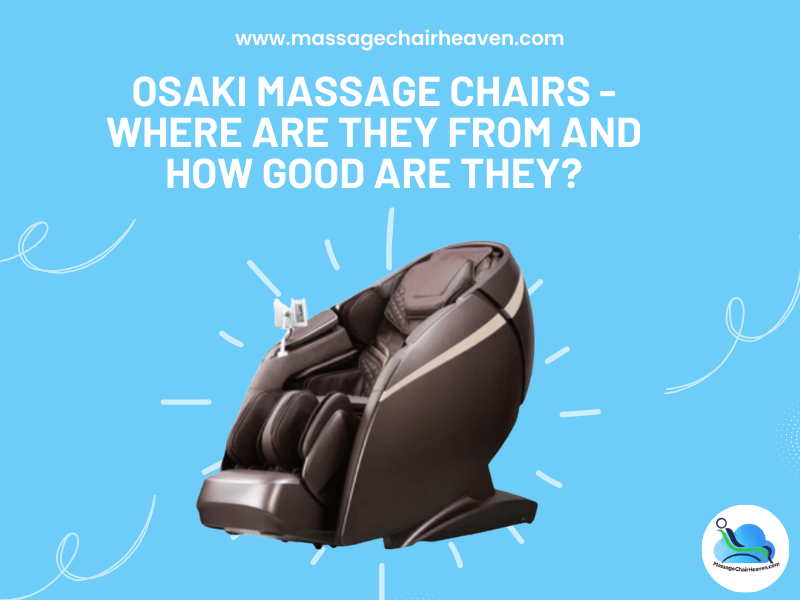
Look at the type of roller mechanism and the area it reaches. Roller tracks are often described by their shape and coverage, such as S-track or L-track designs. An S-track generally follows the natural curve of the back, while an L-track continues farther beneath the seat area. Neither design is universally better; the important question is where the rollers travel and whether that coverage suits you.
Also consider whether the chair’s massage programs let you adjust intensity, roller width, speed, location, or technique. Strong rollers may appeal to some users but feel uncomfortable to others, particularly on the upper back, shoulders, or lower back.
Check body-size fit before focusing on features
A feature-rich massage chair can still be a poor purchase if the shoulder position, seat width, calf section, or footrest range does not fit the intended user. Body scanning can help a chair locate the user’s shoulders, but it cannot fully overcome a frame that is too narrow, too short, or too long.
Pay attention to:
- Recommended user height and weight guidance, when provided by the manufacturer
- Shoulder width and whether the chair’s shoulder cushions feel restrictive
- Seat depth and hip room
- Leg and footrest extension range
- Calf massager fit, especially for users with larger or smaller calves
- Ease of entering and exiting the chair, particularly when it sits low to the floor
If possible, try the exact model in person. If that is not possible, study the measurements, read the return policy carefully, and buy from a seller that can answer fit questions directly.
Separate comfort features from medical claims
Massage chairs may be used for relaxation, temporary comfort, and a soothing massage experience. They are not a substitute for medical diagnosis or treatment. Be cautious with marketing language that suggests a chair can cure, prevent, or fix a medical condition.
People with a health condition, recent surgery, pregnancy, implanted medical devices, circulation concerns, or significant pain should seek appropriate medical guidance before using a massage chair. It is also sensible to start with lower intensity and shorter sessions until you know how the chair feels.
Common Misunderstandings About Osaki Chair Origin
A U.S. seller does not mean U.S. manufacturing
An authorized dealer may operate entirely in the United States, provide domestic phone support, and arrange local delivery. Those are valuable services, but they do not change the country where the chair was assembled.
Imported does not mean unsupported
Many imported massage chairs have established warranty and service pathways. The key is to verify the actual support process for your location and model instead of making assumptions based on manufacturing country.
One model’s origin does not prove every model’s origin
Brands can add, discontinue, update, or source models differently over time. Production may also shift between factories. Treat a label or manufacturer confirmation as model-specific information.
Feature names are not manufacturing evidence
Names for massage programs, zero-gravity positions, body scans, air-cell systems, or roller tracks can be useful for comparing functions. They do not identify the factory, the component source, or the quality-control standards behind a chair.
Questions to Ask Before You Buy
A short conversation with the seller can reveal more than a long feature list. Ask these questions before placing an order:
- What is the country of origin for this exact model and current production version?
- Who handles warranty claims after delivery?
- Is in-home service available at my address?
- Are common replacement parts stocked in North America?
- What are the chair’s assembled and boxed dimensions?
- How much wall clearance and front clearance does it need when reclining?
- What is the return policy if the chair does not fit through my home or does not fit my body comfortably?
- Does the listed price include delivery, setup, and packaging removal, or are those separate services?
The best Osaki massage chair is not necessarily the model with the longest feature list. It is the one that fits the user, fits the room, provides a massage style the user enjoys, and comes with support terms that are clear before the chair arrives.

Credit: massagechairheaven.com
Frequently Asked Questions
Are Osaki massage chairs made in Japan?
Osaki massage chairs are generally manufactured in China, not Japan. A Japanese-sounding brand name should not be used as evidence of Japanese manufacturing. Confirm the country of origin on the label or through the seller for the exact model you are considering.
Is Osaki an American company?
Osaki is marketed and distributed to North American consumers, with U.S.-based sales and support infrastructure associated with the brand. That commercial presence is separate from the overseas manufacturing of the chairs themselves.
Can two massage chair brands use similar chair designs?
Yes. OEM and ODM arrangements can lead to related chair platforms appearing under different brands. The final versions may still differ in software, upholstery, included features, warranty coverage, dealer support, and quality-control requirements.
Does a chair’s country of origin affect its warranty?
Not directly. Warranty quality depends on the written terms, available parts, service network, retailer, and brand support process. A chair made overseas can have strong support, while any chair can be difficult to service if the warranty process is unclear.
What should matter most when choosing an Osaki massage chair?
Prioritize body fit, roller coverage, intensity adjustment, recline space, delivery access, warranty details, and service availability. Manufacturing origin is useful context, but those factors will have a greater effect on daily comfort and long-term ownership.