
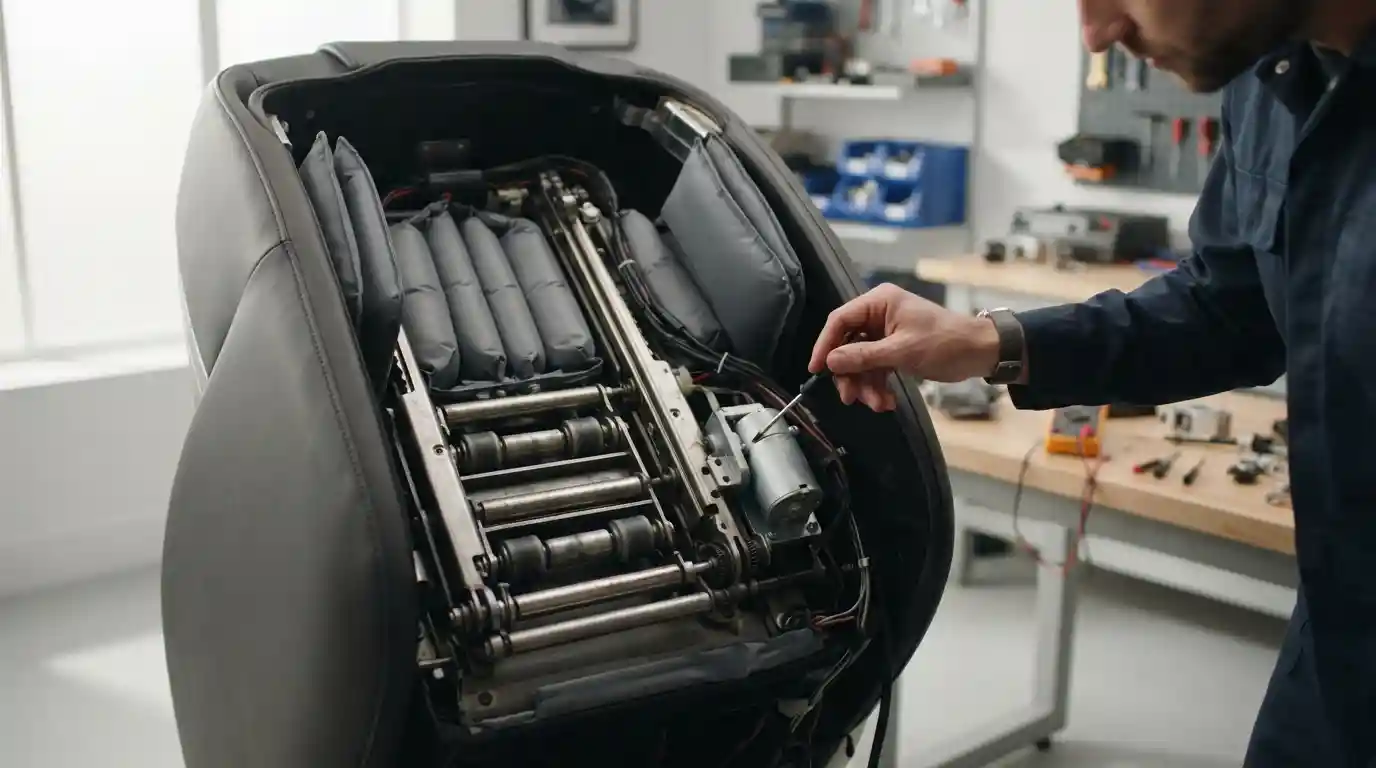
Massage chair parts are not universally interchangeable. Motors, rollers, airbags, remotes, circuit boards, and smaller fittings are usually designed around a specific chair model, production run, and electrical system. Finding the right component starts with identifying the failed part, confirming its exact specifications, and checking whether the manufacturer supports a direct replacement.
Some repairs are straightforward, such as replacing a detachable remote, power cord, air hose, or worn upholstery cover. Others involve high-voltage electronics, heavy moving assemblies, or pressurized air systems and are better handled by an authorized technician. This guide explains what the major massage chair parts do, how failures commonly appear, and how to choose compatible replacements without guessing.
Before ordering any massage chair replacement parts, locate the model label, serial number, and, if available, the part number printed on the original component. Clear photos of connectors, wiring labels, and mounting points can also prevent an expensive mismatch.
The Main Parts Inside a Massage Chair
A massage chair combines mechanical, electrical, and pneumatic systems. A symptom that appears to come from one area can sometimes originate elsewhere. For example, rollers that stop moving may be caused by the roller motor, but they may also be affected by a damaged harness, control board fault, jammed track, or safety sensor.
| Part or system | Primary function | Common signs of trouble |
|---|---|---|
| Massage rollers | Deliver kneading, tapping, rolling, or similar massage motions along the back track | Uneven movement, clicking, binding, no massage motion, rough feel |
| Drive and recline motors | Move roller assemblies, footrests, recline mechanisms, or other powered sections | Humming without movement, slow travel, no movement, repeated stopping |
| Airbags and air cells | Provide compression massage around the shoulders, arms, hips, calves, or feet | One area does not inflate, weak compression, hissing, uneven pressure |
| Air pump and hoses | Generate and route air to airbags | Air pump noise with no inflation, leaks, disconnected tubing |
| Remote or control panel | Select programs and send commands to the chair | Unresponsive buttons, blank display, intermittent operation |
| Control board and wiring harness | Coordinate power, sensors, motors, pumps, and user controls | Multiple systems fail, error display, random shutdowns, no response |
Massage Chair Motors: What They Control
Most massage chairs use more than one motor. The roller carriage may have separate motors for travel along the track and for producing massage actions. Reclining chairs may also use dedicated motors for the backrest, legrest, footrest extension, or zero-gravity-style positioning. Air pumps use their own motor-driven system.
Because motor roles vary by design, a motor that looks similar is not automatically a valid replacement. Voltage, connector type, gear ratio, mounting position, shaft design, rotation direction, load rating, and control-board compatibility can all matter.
Common motor-related symptoms
- No sound and no movement: This may indicate a power supply, fuse, remote, wiring, sensor, control board, or motor issue.
- A hum or buzz without movement: The motor may be stalled, a gear may be damaged, or the mechanism may be obstructed.
- Movement only in one direction: A switch, limit sensor, relay, wiring connection, or control issue may be involved.
- Slow, jerky, or noisy travel: Wear in gears, rails, bearings, or the motor itself can cause this behavior.
- Recline stops before reaching its normal position: Check for an object beneath or behind the chair before assuming the actuator or motor has failed.
When a motor should be replaced
A motor is a sensible replacement candidate when a qualified diagnosis confirms that power reaches the motor correctly, the mechanism is not blocked, and the motor or integrated gearbox has failed. Replacing it without checking the surrounding system can waste money and leave the original fault unresolved.
Motor replacement can require removing upholstery panels, disconnecting wiring harnesses, supporting heavy chair sections, and correctly aligning moving parts. Unplug the chair before opening it. If the repair involves a reclining actuator, roller carriage, or exposed electrical connections, professional service is often the safer option.
Rollers, Tracks, and Massage Mechanisms
Rollers are the moving massage heads that contact the body through the chair’s padding. Depending on the design, they may travel along a straight, curved, or extended track. Their movement is controlled by a carriage, gears, belts, rails, sensors, and one or more motors.
When people search for replacement parts for massage chair rollers, they may actually need a different component in the mechanism. A rough or uneven massage does not always mean the roller heads themselves are worn out. The cause could be a dry or damaged guide rail, loose drive belt, cracked gear, misaligned carriage, or failing travel motor.
Signs of a roller assembly problem
- Rollers stop at one point on the back track.
- The chair makes grinding, knocking, or repetitive clicking sounds.
- One side of the roller mechanism moves differently from the other.
- The massage heads feel unusually uneven or press too strongly in one area.
- The chair begins a massage cycle but ends it immediately.
What to inspect before ordering roller parts
First, run the chair without anyone sitting in it, if the manufacturer’s instructions allow this. Listen for abnormal sounds and observe whether the carriage moves smoothly. Look for visible obstructions, loose items caught in the mechanism, damaged fabric, or a track that appears bent or misaligned.
Do not apply household oils or lubricants unless the manufacturer specifically recommends them. Some products can attract dust, damage plastic components, stain upholstery, or interfere with parts that require a particular lubricant. A technician can determine whether the issue is a serviceable alignment or lubrication problem rather than a need for new rollers.
Airbags, Air Cells, Pumps, and Hoses
Air massage systems use an electric pump to inflate and deflate flexible airbags, sometimes called air cells. These components may be located in the shoulders, arm channels, seat, hips, calves, feet, or other contact areas. Valves and air hoses direct pressure to each zone according to the selected program.
Airbags can eventually develop leaks from repeated folding, material aging, punctures, or stress at seams and hose connections. However, weak inflation can also be caused by a loose tube, blocked line, leaking valve, or worn pump. Replacing an airbag before identifying the leak source may not solve the problem.
How air system failures usually appear
- One chamber never inflates: Often linked to that airbag, its hose, or its valve path.
- Several zones have weak pressure: The pump, main air line, valve assembly, or a large leak may be responsible.
- Inflation begins but fades quickly: This commonly suggests an air leak.
- Constant hissing: A disconnected hose, split tube, leaking fitting, or damaged air cell is possible.
- Pump is silent: Check power, program settings, wiring, and the pump circuit before concluding the pump has failed.
Choosing replacement airbags and tubing
Massage chair spare parts for air systems should match the original shape, connection style, placement, and intended pressure range. An airbag that is merely similar in size may fold incorrectly, rub against internal components, or deliver uneven compression. Likewise, tubing must fit the chair’s connectors securely without kinking.
Do not patch an airbag with an unapproved adhesive or tape where it may be repeatedly compressed against the body. A temporary patch can fail, interfere with the chair’s movement, or create an uncomfortable hard spot. If an exact replacement is unavailable, ask the manufacturer or an established repair provider whether a compatible air-cell assembly exists.
Remotes, Control Panels, and Electronics
A remote control is one of the most visible massage chair parts, but it is not always the cause of a chair that will not start. Some chairs have a detachable wired remote; others use a built-in armrest controller, touchscreen, voice function, or wireless handset. A failed display or button may result from the remote itself, its cable, the socket, a power problem, or the main control board.
Remote problems that may have simple fixes
- Confirm that the chair is connected to a working outlet and that its main power switch is on.
- Check whether the remote cable is fully seated and free of cuts, pinching, or bent connector pins.
- For wireless controls, install fresh batteries of the correct type and follow the chair’s pairing instructions, if applicable.
- Look for a child lock, standby mode, timer setting, or emergency stop feature described in the owner’s manual.
- Restart the chair by turning it off, unplugging it briefly, and reconnecting it only if the manufacturer permits this basic reset procedure.
Never substitute a generic remote solely because the plug fits. The commands, voltage, pin arrangement, communication protocol, and firmware expectations may differ. A model-specific remote or one formally identified as compatible is the safest choice.
Control boards and wiring harnesses
The main control board distributes signals between the remote, motors, air pump, sensors, and power components. A board problem can create confusing symptoms, including several unrelated functions failing at once. Wiring harness damage can produce similar results.
Control boards are particularly model-dependent. Their connectors may fit physically while their programming or electrical layout differs. Unless the manufacturer provides a clear part number match and installation instructions, board replacement should generally be done by a trained repair professional.
How to Identify the Correct Replacement Part
The most reliable way to source massage chair replacement parts is to work from the chair’s identifying information rather than its appearance. Brand names alone are not enough, especially when a company has multiple versions of a chair with similar upholstery or marketing names.
- Find the chair’s identification label. It is often located on the rear, underside, or lower frame. Record the model and serial number exactly.
- Check the owner’s manual and service documentation. Parts diagrams, troubleshooting sections, and approved service contacts can narrow the search.
- Read the original part label. For motors, pumps, remotes, power supplies, and boards, note every number, voltage marking, connector label, and revision code.
- Photograph the part and connections. Include mounting holes, cable length, plugs, hose fittings, and surrounding components.
- Ask for confirmation before purchase. Provide the chair model, serial number, and original part details to the supplier.
- Review the return policy. Electrical and installed parts may have restricted returns, so verify compatibility first.
Original, compatible, and used parts
Original equipment parts are made or specified for the chair’s design and are generally the lowest-risk option when available. Compatible parts may work if their fit and electrical requirements are confirmed, but the word “compatible” should be supported by specific model information rather than a broad claim.
Used components can be useful for discontinued chairs, particularly cosmetic panels, frames, or non-electronic pieces. They carry more uncertainty for motors, pumps, remotes, and circuit boards because remaining service life and prior damage may be difficult to assess. If buying used, compare labels closely and inspect for corrosion, cracked housings, cut wires, and damaged connectors.
Parts That Are Often Replaced
Availability depends on the manufacturer and chair age, but certain components are more commonly requested than others. Some are practical owner replacements, while others need careful diagnosis and disassembly.
- Remote controls and remote cables: Often replaceable when a confirmed model-specific part is available.
- Power cords, fuses, and external switches: Must match the chair’s electrical requirements; damaged cords should not be repaired with makeshift methods.
- Air hoses, connectors, and airbags: Require correct routing and secure connections to avoid leaks and pinching.
- Footrest rollers, covers, pads, and small trim pieces: May be easier to replace when sold as service parts.
- Drive motors, recline actuators, and pumps: Usually require mechanical and electrical work.
- Roller assemblies, gears, belts, and tracks: Often demand significant disassembly and adjustment.
- Control boards and sensor assemblies: Best replaced only after accurate fault diagnosis.
Safety Boundaries for Massage Chair Repairs
A massage chair is heavy and contains moving mechanisms that can pinch fingers or shift unexpectedly. It also uses electrical components that may retain risk even after basic troubleshooting. Disconnect power before inspecting internal parts, and do not operate the chair with covers removed unless an authorized service procedure explicitly requires it.
Stop using the chair and seek qualified service if you notice a burning smell, smoke, sparking, melted insulation, repeated tripping of a breaker, fluid exposure near electrical parts, severe grinding, or a recline mechanism that cannot support the chair safely. Do not bypass fuses, limit switches, thermal protection, or safety sensors to make a chair run.
If the chair remains under warranty, opening panels or installing unapproved replacement parts may affect coverage. Check the warranty terms and contact the manufacturer before undertaking anything beyond the user-serviceable steps in the manual.
When Repair Makes Sense and When It May Not
Replacing a remote, hose, airbag, or accessible actuator can extend the useful life of a chair when the structure, upholstery, and main electronics remain in good condition. Repair is especially reasonable when the manufacturer still supplies parts and can confirm compatibility.
A broader assessment may be wiser when several systems are failing at once, the frame is damaged, replacement electronics are unavailable, or the chair has recurring faults after repair. In that situation, request a diagnosis that distinguishes a single failed component from a larger wiring, board, or mechanical problem. The cost of parts, labor, shipping, and future support matters more than the price of one component alone.
Frequently Asked Questions
Can I use a universal massage chair remote?
Usually not. Massage chair remotes often use model-specific wiring, commands, and connectors. A universal remote may not communicate with the chair even if it appears physically similar. Use a replacement confirmed for the exact model whenever possible.
Why does my massage chair inflate in some areas but not others?
A localized inflation problem commonly points to an airbag, hose, connector, or valve serving that area. Inspect visible tubing for disconnection or damage, but avoid dismantling sealed or complex sections unless you have the proper instructions.
Can a broken massage chair motor be repaired instead of replaced?
Sometimes, but it depends on the motor design and fault. A technician may be able to address a connection, gear, or mounting issue. Sealed motors and integrated gearboxes are often replaced as complete assemblies when they fail.
Where can I find parts for an older discontinued massage chair?
Start with the original manufacturer or its authorized service network. If the part is no longer supplied, reputable repair specialists, furniture service companies, and carefully verified used-part sources may help. Match labels and connectors rather than relying on appearance.
Do I need a technician to replace a massage chair control board?
In most cases, yes. Control boards are model-specific and can be damaged by incorrect handling, wiring, or static electricity. A technician can also confirm that the board is actually the failed component before a replacement is ordered.
Sources & References
Part numbers, electrical specifications and service procedures vary by model. Confirm compatibility from the manufacturer before ordering or installing replacement components.
2 thoughts on “Massage Chair Parts: Motors, Rollers, Airbags, Remotes and Replacements”