
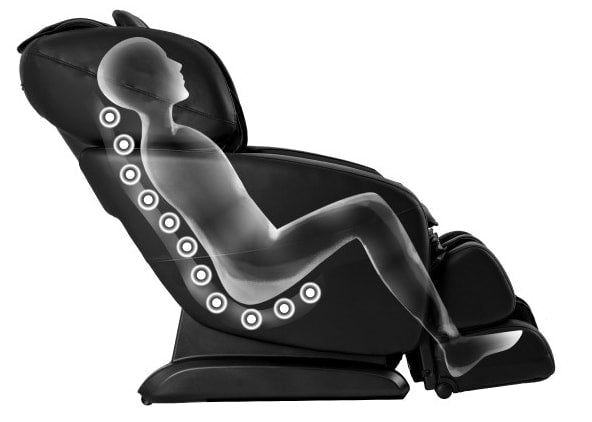
An l track massage chair uses a long, curved roller track designed to follow the shape of the back and continue beneath the seat toward the upper hamstrings. Compared with a shorter massage track, its main advantage is broader roller coverage in one continuous path.
That extra coverage can make an L-track design appealing for people who want attention not only across the neck, shoulders, and back, but also around the glutes and the back of the thighs. However, track length alone does not determine whether a chair will feel effective or comfortable. Roller design, body scanning, air compression, seat shape, intensity settings, and user fit all matter.
This guide explains what an L-track massage chair does, where its coverage begins and ends, the practical benefits it may offer for relaxation, and the limitations to consider before choosing one.
What Is an L-Track Massage Chair?
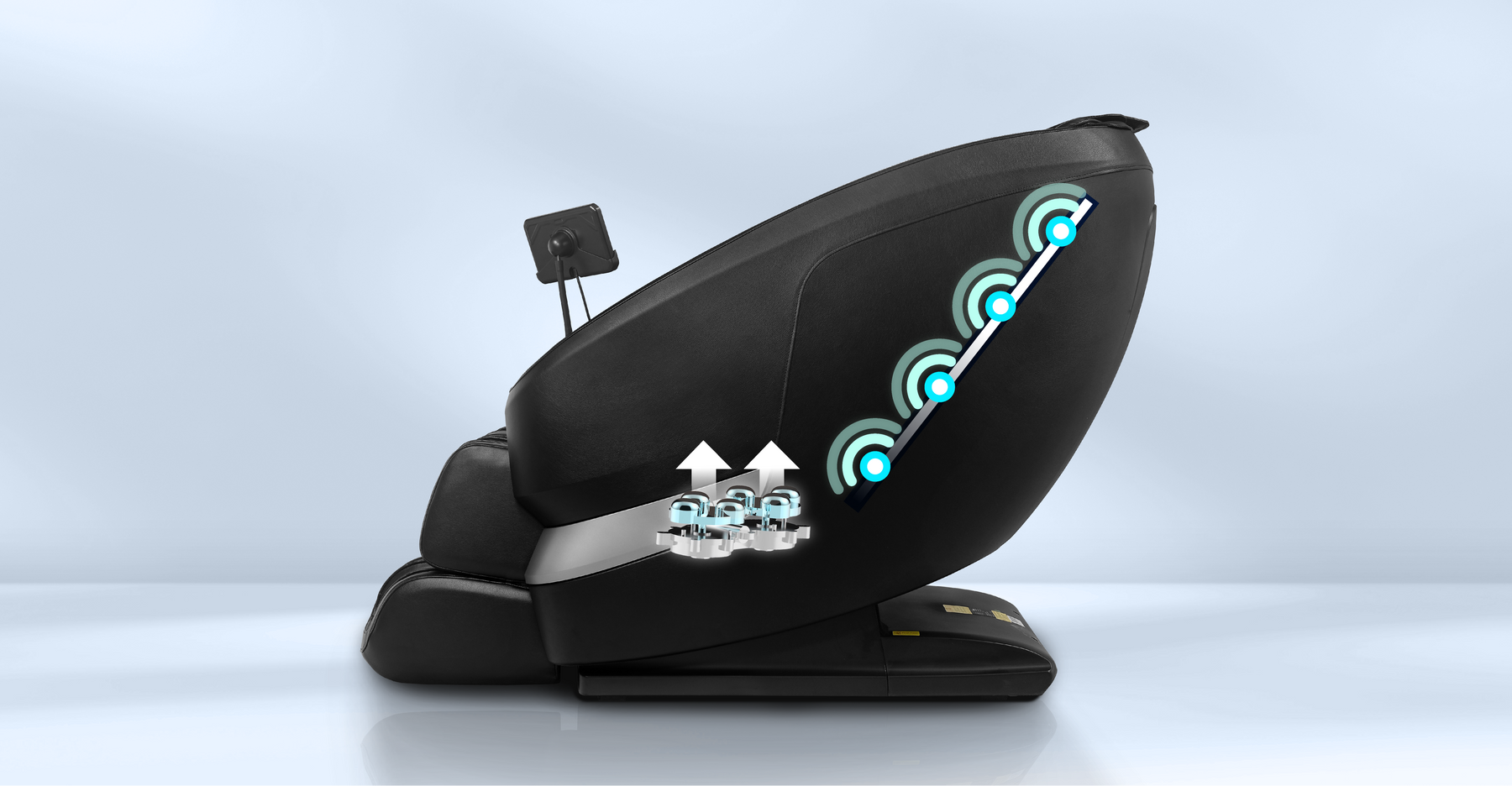
An L-track massage chair is a chair whose massage rollers travel along a rail shaped roughly like the letter “L.” The track starts high on the backrest, runs down the spine area, then curves beneath the seat.
Most models position the rollers to work alongside the spine rather than directly on the spinal bones. As the rollers move downward, the track’s curved lower section allows them to massage the lower back, gluteal area, and, depending on the chair’s design and the user’s height, part of the upper hamstrings.
The term describes the path of the rollers, not every massage feature in the chair. A massage chair L track may also include airbags, foot rollers, heat, recline functions, stretching programs, Bluetooth audio, or app controls. Those features are separate from the track itself.
How the roller system works
Inside the backrest, a motorized mechanism moves the roller assembly up and down the track. The rollers may perform techniques such as kneading, tapping, rolling, shiatsu-style pressure, or combinations of these movements. The available techniques vary by model.
Many chairs also use a body scan at the beginning of a session. This process attempts to detect shoulder position and body contours so the rollers can better align with the user’s back. It can improve fit, but it is not perfect. Tall, short, broad-shouldered, or unusually proportioned users may still need to adjust the shoulder setting manually if the chair allows it.
L-track versus S-track
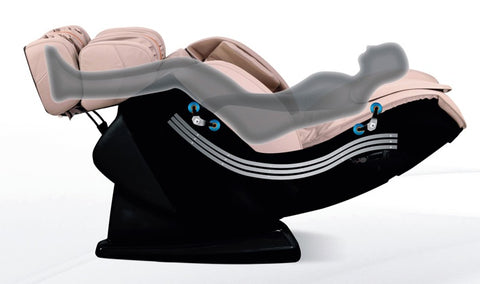
The most common comparison is between L-track and S-track massage chairs. An S-track follows the natural S-shaped curve of the spine from the neck and shoulders to the lower back. It generally stops near the end of the backrest rather than traveling under the seat.
An L-track combines a spine-following back path with an extended lower section under the seat. In practical terms, it adds roller work around the glutes and upper thigh area.
| Feature | L-Track | S-Track |
|---|---|---|
| Roller path | Down the back and under the seat | Follows the back’s natural curve |
| Typical coverage | Neck, shoulders, back, lower back, glutes, upper hamstrings | Neck, shoulders, back, and lower back |
| Glute massage from rollers | Usually included | Usually limited or absent |
| Best for | People who value extended lower-body roller coverage | People focused mainly on back contour and spinal-area massage |
| Potential fit consideration | Seat shape and roller position can feel intrusive for some users | May feel less comprehensive below the lower back |
Neither track is automatically better for every person. An L-track design offers more reach, while a well-designed S-track chair may be a better match for someone who dislikes roller pressure beneath the seat or prefers a more back-focused session.
Where an L-Track Massage Chair Provides Coverage
The exact coverage depends on track length, chair geometry, roller reach, and the user’s body size. Marketing terms such as “full body” can be helpful shorthand, but they should not be read as a guarantee that rollers will reach every area equally.
Neck and shoulders
At the top of the track, rollers commonly address the upper back, trapezius muscles, and shoulder area. This is one of the most important zones to check during setup. If the rollers sit too high, they may press uncomfortably into the neck. If they sit too low, they may miss the shoulders.
Look for shoulder-position adjustment and a body scan that can be fine-tuned. Users with a long torso or broad shoulders should pay particular attention to the stated height range and whether manual adjustment is available.
Mid-back and lower back
Through the central portion of the track, the rollers work along the muscles beside the spine. Programs may use broad rolling strokes for gentler relaxation or more focused kneading and tapping patterns for stronger stimulation.
Lower-back comfort is highly personal. Some people enjoy firm roller pressure in this area, while others prefer a gentler setting or a thicker removable pad. A chair with several intensity levels is more useful than one that is simply marketed as powerful.
Glutes and upper hamstrings
The curved bottom of an L-track is what distinguishes it from a standard S-track. The rollers continue past the lower back and beneath the seat, where they may massage the gluteal muscles and the upper portion of the hamstrings.
This added path is useful for users who spend long periods sitting, driving, or exercising and prefer massage that does not stop at the waist. Still, the sensation can be surprisingly strong because body weight presses into the seat. A good L-track chair should offer a way to reduce roller intensity, select a narrower massage area, or add cushioning.
Areas rollers do not fully replace
Even the longest track does not mean every part of the body receives roller massage. The hips, outer thighs, calves, feet, arms, and hands are generally handled by airbags, foot rollers, vibration, or separate massage components where included.
For example, a chair may have excellent L-track coverage but relatively basic calf compression. If foot and leg massage is a priority, assess those features separately rather than assuming the track design covers them.
Potential Benefits of an L-Track Design
The primary benefit of an L-track is not that it delivers a fundamentally different type of roller massage. It is that the massage can continue farther down the body without requiring the user to reposition themselves.
Credit: osakimassagechair.com
More continuous lower-body coverage
The transition from the lower back into the glute and upper hamstring area creates a more continuous massage path. For some people, this feels more complete than a session that ends at the lower back.
It can be especially appealing when the user wants a relaxing session after desk work, travel, standing, or recreational activity. These are comfort and recovery-oriented uses, not a substitute for diagnosis or treatment of pain, injury, or a medical condition.
Less reliance on airbags for the seat area
Airbags can compress and hold the hips or thighs, but they do not create the same moving kneading sensation as rollers. An L-track lets the chair apply roller-based massage under the seat while airbags, if present, can add compression around the hips and thighs.
This combination may feel more varied than air compression alone. It also gives users more control when the chair allows independent settings for rollers and airbags.
Useful for people who prefer full-session relaxation
A longer massage path can make automatic programs feel more immersive. Instead of concentrating only on the upper body, a program can alternate between shoulder work, back massage, and lower-seat coverage.
That broader approach may suit people who use a massage chair primarily for unwinding. It does not necessarily suit someone seeking a brief, targeted upper-back session, although many L-track chairs allow users to choose a specific region.
May provide better value for the right priorities
If glute and upper-hamstring roller massage is important to you, choosing an L-track can prevent disappointment later. It is often easier to select a chair with the coverage you want from the start than to hope seat airbags will create a similar effect.
That said, a longer track should not outweigh poor ergonomics, weak adjustability, limited body-size compatibility, or an uncomfortable seat. Coverage has value only when the chair fits the person using it.
Limitations and Trade-Offs to Understand
L track massage chairs have meaningful advantages, but their extended roller path also creates compromises. Knowing these limitations helps separate a genuinely suitable chair from one that merely has an impressive feature list.
More coverage can mean more pressure
Under-seat rollers can feel intense, particularly during kneading or shiatsu-style programs. The user’s weight naturally places the glutes close to the mechanism, so even a moderate setting may feel forceful.
People who prefer gentle massage should look for adjustable roller intensity, a removable back pad or seat pad, and the ability to turn off or reduce certain zones. Do not assume that a “gentle” automatic program will be gentle enough without testing or reviewing the control options.
The upper-thigh reach is limited
An L-track typically reaches the upper hamstrings, not the entire length of the thighs. It does not replace a dedicated thigh-massage system, and it generally will not reach the knees.
Likewise, the sensation beneath the seat depends heavily on leg length and seated posture. On one user, the rollers may land comfortably beneath the glutes. On another, they may feel too far forward or too far back.
Body fit remains essential
Track design does not solve fit problems. A chair can have a long rail but still be uncomfortable if the seat is too narrow, the shoulder placement is wrong, the footrest is too short, or the calf section does not fit properly.
Before buying, check the manufacturer’s recommended user height range, maximum supported weight, seat dimensions where provided, and calf or footrest adjustment. These specifications are model-specific, so avoid relying on general assumptions about all L-track chairs.
Longer tracks do not guarantee better rollers
Roller mechanism quality matters as much as track length. Chairs may use different roller configurations and movement capabilities. A sophisticated roller system may better vary the width, depth, and style of massage, while a simpler mechanism may provide a less nuanced experience even on a long track.
When comparing models, ask practical questions:
- Can the roller intensity be adjusted independently from air compression?
- Can you change roller width or focus on a specific body zone?
- Does the chair permit manual shoulder-position adjustment after scanning?
- Can the under-seat roller area be reduced or avoided in a custom program?
- Are there enough speed and technique settings to suit more than one user?
Space and movement requirements can be substantial
Many massage chairs need room behind and in front of the chair for reclining and leg-rest extension. Some use space-saving slide-forward mechanisms, but the required wall clearance still varies by model.
Measure the intended location with the chair fully reclined, not only in its upright position. Account for access around the sides, doorways, power outlets, and the path needed to bring the chair into the room. A large chair that fits on paper may be difficult to move through a narrow hall or stairway.
Massage chairs are not medical devices for most users
An L-track massage chair can support relaxation and may feel soothing after normal daily activity. It should not be presented as a cure or treatment for sciatica, disc problems, arthritis, circulation disorders, sports injuries, or other health conditions.
Anyone who is pregnant, has an implanted medical device, has recently had surgery, takes medication that affects bleeding or sensation, or has a significant medical condition should seek advice from a qualified healthcare professional before using a massage chair. Stop using the chair if it causes pain, numbness, dizziness, or worsening symptoms.
Features That Matter Alongside the Track
When comparing l track massage chairs, treat the rail shape as one part of a larger system. The following features often have a greater effect on day-to-day satisfaction than a small difference in advertised track length.
Credit: massagechairdeals.com
Recline position and zero-gravity styling
A reclined position can distribute body weight differently and may reduce the feeling of being compressed into the seat. Chairs described as “zero gravity” generally raise the legs and recline the body into a more supported position, though the exact angle and comfort vary.
Recline can change how roller pressure feels, especially around the lower back and glutes. A chair that feels too strong upright may feel more balanced when reclined, while some users may prefer upright sessions for better control.
Air compression zones
Airbags can add compression to the shoulders, arms, hips, calves, and feet. Their usefulness depends on placement and adjustability. Too much pressure can feel restrictive; too little may be barely noticeable.
Independent airbag controls are valuable because different body areas often need different settings. A person may enjoy strong calf compression but want low-pressure shoulder airbags, for example.
Footrest and calf fit
Foot and calf systems are separate from the L-track, but they strongly influence whether a chair feels like a full-body model. Look at whether the leg rest extends for different heights, how easily it accommodates your feet, and whether the calf section feels secure without pinching.
If multiple household members will use the chair, adjustable leg length and simple controls become even more important.
Controls and program customization
A remote or app should make it easy to select a body region, adjust intensity, and stop a program promptly. Complex controls can turn useful features into settings that never get used.
Useful customization options may include:
- Roller intensity, speed, and width adjustments
- Air compression intensity controls
- Targeted back, lower-back, or glute-area programs
- Heat controls where available
- Manual massage modes and saved custom programs
- Session timers and easy pause or stop functions
How to Decide Whether an L-Track Is Right for You
An L-track chair is usually a strong match if you specifically want roller massage to continue below the lower back. It can also suit users who value automated, whole-body relaxation sessions and want more than shoulder-to-waist coverage.
It may be less suitable if you are highly sensitive to firm massage beneath the seat, have a body shape that does not fit the chair’s stated range, or mainly want targeted neck and upper-back work. In those cases, a well-fitted S-track chair or another massage solution may be the more comfortable choice.
Credit: youneedmassagechair.com
A practical buying approach
- Define your priority zones. Decide whether glute and upper-hamstring massage genuinely matters to you.
- Check body-size compatibility. Review the manufacturer’s user guidance and consider every regular user, not just the primary buyer.
- Assess intensity control. Make sure roller and airbag settings can be reduced, especially if you are new to massage chairs.
- Review the reclined footprint. Measure both the room and the delivery route before ordering.
- Compare the complete massage system. Evaluate rollers, airbags, calf and foot components, controls, materials, and service support together.
- Understand return and warranty terms. Large chairs can be difficult and expensive to return, so verify the seller’s policy before purchase.
The best choice is not necessarily the chair with the longest advertised track. It is the one whose roller coverage, pressure range, controls, dimensions, and seating comfort match the way you expect to use it.
Frequently Asked Questions
Is an L-track massage chair suitable for tall users?
It can be, but track type alone does not determine suitability. Tall users should verify the recommended height range, shoulder adjustment range, footrest extension, and whether the calf section fits comfortably. A body scan helps, but manual adjustment is still valuable.
Can two people with very different heights use the same L-track chair?
Yes, if the chair has a broad user-fit range, adjustable shoulder positioning, and an extendable leg rest. Each person may need to run the body scan and change settings before a session. A chair with limited adjustment may feel comfortable for one user and poorly aligned for another.
Do L-track chairs always include foot rollers?
No. The L-track refers only to the back-and-seat roller path. Foot rollers, calf massage, heating elements, and airbags are separate features that must be checked in the individual chair’s specifications.
How long should a massage chair session last?
Follow the chair manufacturer’s instructions and start with shorter, lower-intensity sessions while learning how your body responds. Many chairs include timers for this reason. Longer or stronger sessions are not automatically more beneficial if they leave you uncomfortable or sore.
What maintenance does an L-track massage chair need?
Keep the chair clean according to the manufacturer’s material-care instructions, avoid blocking moving parts, and inspect the power cord and upholstery periodically. Do not attempt to dismantle the roller mechanism yourself. For unusual noises, repeated errors, or movement problems, contact the manufacturer or an authorized service provider.