
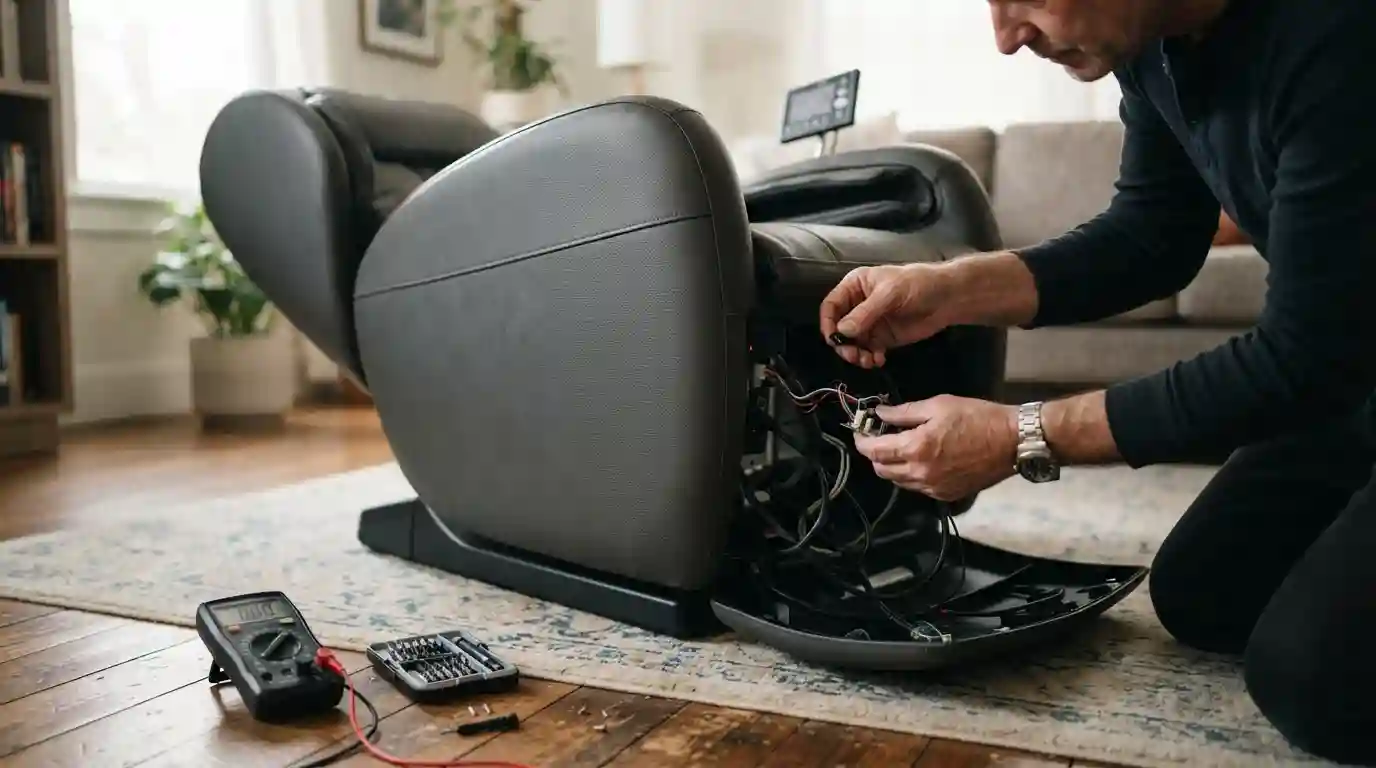
Osaki massage chair repair usually starts with a simple question: is the problem caused by power, settings, a connection, a mechanical part, or the chair’s control system? Many apparent failures—such as a chair that will not start, will not recline, or seems to stop mid-massage—can be narrowed down safely before arranging service.
Osaki sells massage chairs with different roller systems, air-cell layouts, remotes, recline mechanisms, and smart features. That means the correct repair procedure depends on the model and its symptoms. Avoid assuming that a part from one chair will fit another, even if the chairs look similar.
This guide explains common faults, practical troubleshooting steps, and when an authorized technician is the safer choice for Osaki massage chair repair. For issues involving electrical components, motors, wiring, or the massage mechanism, stop work if you are unsure. A massage chair is heavy, contains moving parts, and may retain electrical risk even when it is switched off.
Start With the Basics Before Assuming a Major Failure
A systematic check can prevent unnecessary repairs. Before removing covers, disconnecting cables, or ordering parts, confirm that the chair has power and that a selected program is supposed to activate the feature you are testing.
- Turn the chair off and unplug it. Leave it disconnected briefly, then reconnect it directly to a known working wall outlet.
- Check the main power switch. Many chairs have a rocker switch near the rear or lower side of the base in addition to the power button on the remote.
- Inspect the power cord. Look for cuts, crushing, loose connections, discoloration, or signs that the cord has been pulled from the chair.
- Check the remote and its cable. Make sure the plug is fully seated, the cable is not pinched, and the remote has no visible damage.
- Allow the chair to cool down. A chair that has run repeatedly or for long sessions may temporarily stop certain functions because of motor or thermal protection.
- Read any message on the remote display. Record the exact wording, symbol, or error indication before restarting the chair or calling for service.
Do not use extension cords, power strips, adapters, or a generator unless the chair’s manual specifically permits them. Massage chairs can draw substantial power during operation, especially while reclining and running the massage mechanism at the same time. A poor power connection can cause intermittent shutdowns or damage.
Common Osaki Massage Chair Problems and Likely Causes
| Symptom | Possible Causes | Safe First Checks |
|---|---|---|
| Chair will not turn on | Wall outlet issue, switched-off power supply, damaged cord, loose remote connection, internal fuse or control-board fault | Test outlet, inspect cord, confirm main switch position, reconnect remote cable |
| Remote lights up but massage will not start | Program setting, interrupted startup sequence, sensor or control issue, mechanism fault | Restart chair, choose a basic automatic program, listen for motor activity |
| Rollers stop, click, grind, or move unevenly | Obstruction, worn drive components, rail issue, motor fault, damaged wiring | Stop use, check for loose objects, do not force the rollers |
| Airbags do not inflate or remain inflated | Disconnected hose, leaking air cell, loose fitting, air pump or valve problem | Listen for pump operation and check only accessible external connections |
| Recline or footrest will not move | Obstruction, actuator or motor issue, loose linkage, wiring fault, controller problem | Clear space around chair, remove items beneath it, restart once |
| Heat does not work | Heat setting disabled, program limitation, loose connection, heating-pad or control fault | Confirm the heat setting and test another compatible program |
| Chair stops during use | Overheating protection, overloaded mechanism, power interruption, control-board fault | Unplug, let cool, inspect surroundings, retry only once after reset |
| Bluetooth, speakers, or USB feature fails | Pairing issue, device setting, cable or module fault, model-specific limitation | Remove pairing and reconnect; verify feature availability in the manual |
Power Problems: Chair Will Not Turn On or Shuts Off
A completely unresponsive chair does not automatically need a new motor or control board. Start at the wall outlet and work toward the chair. Plug a small working device into the outlet to confirm that the circuit is live. If the outlet is controlled by a wall switch, make sure that switch is on.
Next, inspect the chair’s power cord without bending, stripping, or opening it. If the plug is hot, the cord is frayed, or there is a burning smell, unplug the chair immediately and do not reconnect it. These are not do-it-yourself repair conditions.
Check the main switch and remote connection
Some massage chairs need both the physical main switch and the remote power button to be on. The chair may appear dead if either is off. If the remote has a detachable cable, unplug and reconnect it gently while the chair is disconnected from power. Do not pull on the wire itself.
If the chair powers on briefly and then turns off, note what happens immediately before shutdown. For example, a shutdown only when reclining points in a different direction than a shutdown that occurs as soon as the rollers begin moving. That information helps a service provider identify whether the issue may involve a motor load, wiring, or control system.
Do not bypass fuses or safety devices
Some owners look for an internal fuse when a chair has no power. Replacing a fuse with the wrong type, bypassing it, or repeatedly replacing a blown fuse can create a fire or shock hazard. A fuse that blows again is a symptom of another fault, not the fault itself. Internal electrical diagnosis should be handled by a qualified technician using the correct model documentation.
Massage Rollers, Tracks, and Mechanism Faults
The roller mechanism is one of the most complex areas of an Osaki massage chair. Depending on the model, rollers may travel on an S-track, L-track, or another shaped rail system, with motors moving the rollers up and down the back and changing their depth, width, or massage style.
Common warning signs include clicking, repeated knocking, grinding, rollers that stop in one area, or massage movement that feels uneven. A chair may also make motor noise without the rollers moving normally.
Credit: massagechairheaven.com
What to check safely
- Turn off and unplug the chair before inspecting the seat, backrest, and footwell.
- Remove loose items such as coins, keys, pens, pet toys, or fabric caught around accessible gaps.
- Check whether a cushion, blanket, or aftermarket pad is interfering with movement.
- Restart the chair without anyone sitting in it, if the manual permits this, and listen for abnormal sound.
- Try a basic full-body program rather than a highly customized setting.
Do not press against the rollers, pull upholstery aside aggressively, lubricate internal rails with household products, or attempt to manually reposition a stuck roller carriage. Lubricants that are not approved for the chair can attract debris, stain materials, or affect plastic and electrical components. Forcing the mechanism can turn a repairable alignment or drive issue into a more extensive failure.
When roller problems need professional repair
Arrange service if the chair grinds, makes repeated loud clicking, stops in the same position every time, or produces a burning odor. A technician may need to inspect the motor, gearbox, drive belt or gear components, sensor system, rail, wiring harness, or control board. The correct repair depends on the model; symptoms alone cannot confirm which part has failed.
Airbag and Air Compression Problems
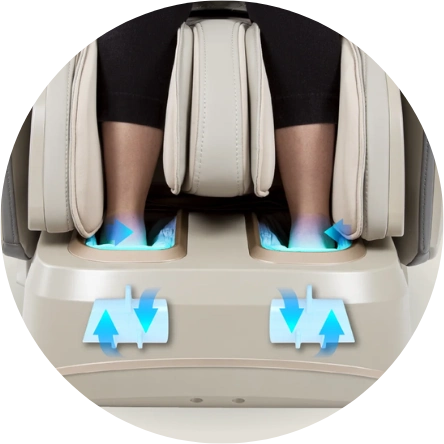
Air compression systems use an air pump, valves, hoses, and inflatable air cells to apply pressure around areas such as the shoulders, arms, hips, calves, or feet. A failure may affect one zone or the entire chair.
If airbags do not inflate, first confirm that air massage is enabled in the chosen program and that the intensity is not set to its lowest level. Some programs emphasize roller massage and may use less air compression than others. If the pump can be heard but one section remains flat, a hose connection, valve, or air cell may be involved. If there is no pump sound in any area, the pump, power supply, wiring, or controller may require diagnosis.
Signs of an air-system leak or blockage
- One airbag inflates weakly compared with the matching area on the other side.
- An area inflates but quickly loses pressure.
- The chair makes a hissing sound during the compression cycle.
- A section stays inflated after the program ends.
- The pump runs longer than usual without creating normal pressure.
Do not puncture, tape, or glue an air cell without guidance from a qualified service source. Accessing air components often requires removing upholstery panels and reconnecting hoses in the proper positions. A loose or crossed hose can create new problems after reassembly.
Recline, Zero-Gravity, and Footrest Issues
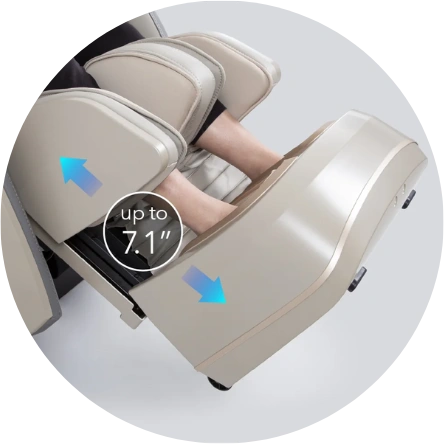
Recline mechanisms use motors or actuators, metal linkages, sensors, and control wiring. The footrest may extend separately, move with the backrest, or include a leg-extension feature depending on the chair. Because these parts move under load, the area beneath and behind the chair must remain clear.
Check for simple obstructions first
Move the chair away from the wall if it is too close. Remove rugs that bunch under the base, charging cables, toys, footwear, and anything that could block the footrest. Check that the chair is on a stable, level surface. An uneven floor can place extra strain on a moving base or make a linkage bind.
If the chair stops while reclining, do not repeatedly press the recline button. Return it to an upright position only if it responds normally. Then unplug the unit and inspect the clearance around the chair. Repeatedly commanding a jammed motor can worsen damage.
Symptoms that point to a mechanical or electrical repair
A footrest that moves on one side only, a backrest that tilts unevenly, a loud clunk during movement, or a recline function that fails despite a clear path typically needs professional assessment. Possible causes include an actuator problem, worn linkage, loose fastener, failed limit sensor, damaged wiring, or a controller issue. These components can be under tension, so avoid disassembly unless you have the manufacturer’s instructions and appropriate technical qualifications.
Remote Control, Touch Panel, and Electronic Feature Failures
When the chair has power but functions do not respond as expected, the remote is an important part of the diagnosis. A dark display, frozen screen, unresponsive buttons, intermittent operation, or a damaged cable can all prevent commands from reaching the chair.
Disconnect power before reseating a detachable remote connector. Check for bent pins, debris, moisture, or a cable that has been sharply kinked. If the remote uses batteries, replace them with the correct type and orientation. Not every Osaki remote uses batteries, so consult the manual for the specific chair.
Credit: massagechairdeals.com
Features may be program-dependent
Heat, zero-gravity positions, calf massage, stretching modes, Bluetooth audio, voice control, and other functions vary by model and may not operate in every automatic routine. Before treating a missing feature as a fault, test it using the chair’s manual mode or the program recommended in the owner’s manual.
For Bluetooth problems, remove the chair from the phone’s saved device list, restart the phone’s Bluetooth setting, and pair again. Keep the phone close to the chair during setup. If audio still fails while the chair’s other functions work normally, the problem may be limited to the speaker, Bluetooth module, or its connection rather than the main massage system.
Heat Function Problems and Safety Boundaries
Many massage chairs provide gentle heat in selected areas, but the location and controls vary. Confirm that the heat option is turned on and that the program supports it. Allow time for the feature to warm up; it may not feel like a high-temperature heating pad.
Stop using the heat function if you notice an electrical smell, unusual hot spots, discoloration, melted material, or a damaged wire. Never place heavy blankets, towels, or objects over a heated area to make it feel warmer. Avoid modifying heating components or using the chair when upholstery is wet.
Heat and massage features are intended for comfort and relaxation, not as treatment for an injury or medical condition. People with reduced sensation, circulation concerns, pregnancy, implanted medical devices, or other health considerations should review the chair manual and seek medical advice when appropriate before use.
A Practical Troubleshooting Sequence
Use this order to avoid overlooking easy fixes and to create useful notes for a repair provider.
- Write down the model and serial number. The model label is often located on the back, side, or base of the chair. Photograph it for reference.
- Describe the exact symptom. Include whether the chair has power, which feature fails, when it fails, and whether there are sounds, lights, or messages.
- Check power and physical clearance. Confirm the outlet, main switch, cord condition, remote connection, and space around moving parts.
- Perform one controlled restart. Unplug the chair, wait briefly, reconnect it, and test a basic program.
- Test one function at a time. Try massage, air compression, recline, footrest, heat, and audio separately where the chair allows it.
- Stop if the chair makes abnormal noise or smells hot. Do not continue testing a potentially damaged motor or electrical circuit.
- Contact the seller, manufacturer support, or authorized service channel. Share the model, serial number, purchase details, photos or video of the symptom, and the steps already taken.
Repair Options: Warranty, Authorized Service, or Independent Technician
The right repair route depends on the chair’s age, warranty status, location, and the type of failure. Start by checking the paperwork supplied with the chair. Coverage can differ for in-home service, parts, labor, and structural components, and terms may vary by seller and model.
Use warranty support when coverage may apply
If the chair may still be covered, contact the retailer or manufacturer before authorizing independent work. Unauthorized repairs, non-approved parts, or opening protected electrical areas may affect warranty eligibility. Have the model number, serial number, proof of purchase, and a concise symptom description ready.
Choose authorized service for model-specific parts
An authorized technician is often the best option for control boards, remotes, roller assemblies, air pumps, actuators, upholstery panels, and internal wiring harnesses. These parts may be model-specific, and correct installation matters as much as the replacement part itself.
Ask the service provider whether the diagnosis is performed in home, whether the chair must be transported, what the labor and travel charges include, and whether replacement parts are new, compatible, or refurbished. Request a written estimate before approving substantial work.
Independent repair may suit some out-of-warranty problems
A reputable independent technician with experience repairing powered recliners or massage chairs may be able to handle certain out-of-warranty issues. Confirm that the technician is comfortable with the chair’s weight, electronic controls, air system, and moving mechanism—not just standard furniture repair.
Independent service can be useful, but compatibility remains critical. Do not buy a generic remote, motor, power supply, or controller solely because its connector looks similar. Incorrect electrical ratings or programming can damage the chair or create a safety issue.
Maintenance That Can Help Prevent Future Faults
Regular care will not prevent every component failure, but it can reduce avoidable strain and keep small problems from becoming larger ones.
- Keep clearance behind, beside, and beneath the chair for recline and footrest movement.
- Use the chair on a level surface and avoid dragging it by the footrest, armrests, or remote cable.
- Follow the owner’s manual for user weight limits and recommended session length.
- Keep liquids away from the remote, side controls, seat, and charging ports.
- Remove loose objects from pockets before using the chair.
- Clean upholstery with products approved for the chair’s material; avoid soaking seams and control areas.
- Inspect the cord and remote cable periodically for wear or pinching.
- Unplug the chair before cleaning or moving it.
If the chair must be moved, use enough people to support its weight and follow the manufacturer’s moving guidance. Many massage chairs are not designed to be lifted by exposed moving components. Improper moving can damage the base, recline mechanism, rollers, or internal connections.
Credit: massagechairdeals.com
Frequently Asked Questions
Why does my Osaki massage chair beep but not begin a massage program?
A beep generally means the chair is receiving a command, but it does not confirm that every component can start. Check that the chair has completed its startup position, select a basic automatic program, and verify that no remote buttons are stuck. If it still beeps without motor or roller activity, the issue may involve the controller, wiring, or massage mechanism.
Can I reset an Osaki massage chair by unplugging it?
Disconnecting the chair from power and reconnecting it can clear some temporary control issues. It will not repair a damaged motor, air pump, actuator, wire, or circuit board. Use a single controlled reset rather than repeatedly cycling power during an active fault.
How can I find the correct replacement part for my chair?
Use the exact model number and serial number from the product label, then contact the retailer, manufacturer support channel, or a qualified service provider. Photos of the existing part and its connectors can help, but visual similarity alone is not enough to confirm compatibility.
Is it safe to use the chair if one massage feature no longer works?
It depends on the symptom. Do not use the chair if there is grinding, burning odor, overheating, damaged wiring, a jammed recline mechanism, or abnormal electrical behavior. If a nonessential feature such as audio fails while all moving and electrical functions operate normally, arrange service before relying on that feature again.
What information should I provide when booking massage chair service?
Provide the chair’s model and serial number, purchase date if available, a clear description of the fault, when it occurs, any display message, and photos or video showing the issue. Also mention whether the chair is on an upper floor, in a tight space, or difficult to access, since this may affect in-home service or transport planning.