
Choosing between an S track vs L track massage chair comes down to more than roller length. The track shape affects where the massage rollers travel, how well the chair follows your back, and whether it can deliver roller massage below the waist into the glutes and upper hamstrings.
An S-track chair is designed to follow the natural curve of the spine. An L-track chair starts with a similar curved path through the back, then continues downward beneath the seat. Neither design is automatically better for every person; the right choice depends on the areas you want treated, your body size, and the chair’s overall fit and massage system.
Track design is only one part of comfort. Roller mechanism, air compression, recline position, body scanning, intensity settings, and seat shape all influence how a massage chair feels in daily use. Understanding the practical differences helps you avoid paying for coverage you may not need—or overlooking features that matter to you.
What the Massage Chair Track Does
The track is the guided path that carries a massage chair’s rollers along the body. In most massage chairs, the rollers move up and down the track while performing techniques such as kneading, tapping, rolling, shiatsu-style pressure, or combinations of movements.
A well-designed track helps rollers stay closer to the body rather than moving in a straight vertical line that may lose contact around the lower back. The track does not determine every massage function, however. Airbags, vibration motors, heat elements, foot rollers, and stretching programs work separately from the main roller track.
When comparing tracks, focus on two questions:
- How closely does the roller path follow the contours of your back?
- How far below the lower back do the rollers continue?
S-Track Massage Chairs: Curved Support Along the Spine
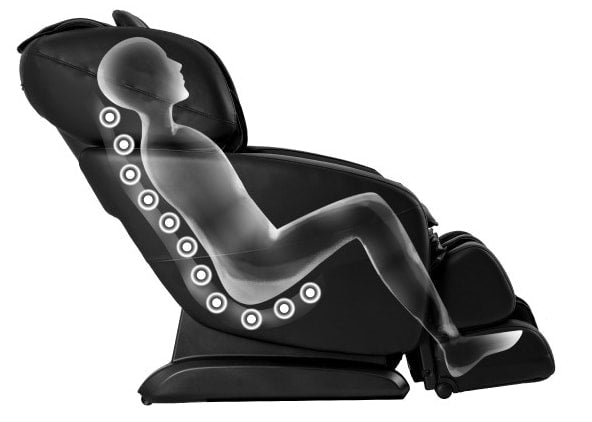
An S-track, sometimes called an S-curve track, is shaped to follow the spine’s natural profile. It generally curves inward around the neck and upper back, outward through the mid-back, and inward again near the lumbar area.
The purpose is to keep the rollers in more consistent contact as they travel from the neck and shoulders toward the lower back. Compared with older straight-track designs, an S-track can feel more tailored because it better accommodates the normal inward curve of the lumbar spine.
Typical S-Track Coverage
S-track rollers usually massage from the upper back or neck area down to the lower back and sacrum. Exact coverage varies by model, body scan accuracy, and the user’s height. Some chairs stop around the lower lumbar region, while others reach farther toward the top of the glutes.
What an S-track generally does not provide is a dedicated roller massage of the full glute and upper hamstring area. A chair may still massage those regions with airbags, vibration, or a heated seat, but those functions feel different from mechanical rollers moving along a track.
How an S-Track Feels
For many people, an S-track feels focused and supportive through the back. Because the rollers are intended to follow the spine’s curves, the chair can maintain pressure in the lumbar area without pressing as aggressively into areas where the back naturally arches away.
This design can be especially appealing if your primary goal is massage for the neck, shoulders, mid-back, and lower back. It may also suit buyers who prefer a simpler chair with fewer moving parts under the seat.
Strengths of an S-Track
- Follows the natural spinal curve for more consistent back contact.
- Often provides strong attention to the neck, shoulders, and lumbar region.
- May be a better fit for people who do not want intense roller pressure in the glutes.
- Can be found in compact massage chair designs, depending on the model.
- Often offers a more straightforward back-focused massage experience.
Potential Limitations
- Roller coverage usually ends at the lower back or upper glute area.
- Glute and hamstring massage may rely mainly on airbags or vibration.
- People seeking broad lower-body roller coverage may find it less complete.
L-Track Massage Chairs: Extended Coverage Below the Lower Back
An L-track begins with a curved back section similar to an S-track. Instead of ending around the lumbar or sacrum area, the track continues downward beneath the seat. This creates an “L” shape when viewed from the side.
The extended section allows the rollers to travel from the neck and shoulders, down the back, across the glutes, and commonly into the upper hamstrings. The exact endpoint differs substantially between chairs. Some stop under the upper thighs, while others extend farther along the hamstrings.
Typical L-Track Coverage
The defining advantage of an L-track is roller access to the lower-body area below the back. This can be useful for people who experience general tightness or fatigue around the hips, glutes, and upper hamstrings after prolonged sitting, driving, training, or standing.
It is important to separate roller coverage from total chair coverage. An L-track does not mean rollers travel all the way to the calves or feet. Lower-leg and foot massage normally comes from airbags, calf compression chambers, dedicated foot rollers, or vibration features.
How an L-Track Feels
An L-track can feel more like a continuous massage from the shoulders into the seat. For some users, the glute roller section adds welcome pressure and makes full-body programs feel more complete. For others, that same pressure can feel too strong, too direct, or awkwardly placed.
Comfort depends heavily on the chair’s settings and construction. The best L-track experience usually includes adjustable roller intensity, a body scan that identifies the user’s shoulder position, and the ability to select or avoid specific massage zones.
Strengths of an L-Track
- Extends roller massage into the glutes and usually the upper hamstrings.
- Creates a more continuous upper- and lower-body massage path.
- Can be appealing for users who want more than a back-only roller massage.
- May add depth to stretching and recovery-oriented programs when paired with airbags.
- Offers a broader massage area without requiring a separate seat massager.
Potential Limitations
- The extended roller path may feel overly intense for users sensitive around the hips or glutes.
- Seat comfort can vary more because rollers and track components are built beneath the sitting area.
- Not every L-track reaches the same point along the thighs.
- A longer track alone does not guarantee better massage quality or better body fit.
S Track vs L Track Massage Chair at a Glance
| Feature | S-Track | L-Track |
|---|---|---|
| Track shape | Curves along the natural shape of the spine | Follows the back curve, then extends beneath the seat |
| Main roller coverage | Neck, shoulders, back, and lower back | Neck, shoulders, back, lower back, glutes, and commonly upper hamstrings |
| Best known for | Back contouring and focused spinal-area massage | Broader continuous roller coverage |
| Glute massage | Usually airbags, vibration, or limited roller reach | Usually included through the extended roller path |
| Seat feel | May feel less mechanically active beneath the seat | May feel more substantial or firmer under the glutes, depending on design |
| Ideal buyer | Someone prioritizing neck-to-lower-back massage | Someone who wants roller massage below the waist |
Credit: massagechairdeals.com
Coverage Differences That Matter in Daily Use
The biggest difference between the two track types is not what happens in the upper back. Both can provide effective coverage there when the chair has capable rollers and proper adjustment. The more meaningful difference begins at the lower back.
Neck and Shoulder Coverage
Neither track type guarantees excellent neck and shoulder massage. That depends on how high the rollers travel, whether the chair offers adjustable shoulder positioning, and how accurately its body scan recognizes your frame.
Taller users should pay close attention to maximum shoulder height and stated user-height guidance. A track may be long, but if the chair positions the rollers too low, the massage can miss the upper trapezius and neck area.
Lower Back and Lumbar Contact
Both S-track and L-track systems are designed to follow the lower-back curve more naturally than a straight track. In practice, the quality of lumbar massage depends on roller projection, intensity controls, and the chair’s recline angle.
A chair that reclines smoothly into a near-weightless position may allow the body to settle against the rollers more evenly. However, deeper pressure is not always more comfortable. Look for adjustable intensity and the ability to narrow, widen, or target the roller position when available.
Glutes and Upper Hamstrings
This is where L-track chairs have a clear functional advantage. The track continues beneath the seat, allowing rolling and kneading movements in areas an S-track generally cannot reach directly.
That said, preferences vary. Some people enjoy the strong, rhythmic sensation of rollers through the glutes. Others prefer gentler air compression in that area. If possible, choose a chair with zone controls, intensity settings, or programs that let you reduce lower-body roller activity without turning off the entire massage.
Comfort Is About More Than Track Length
It is easy to assume that an L-track is more comfortable because it covers more of the body. More coverage can be valuable, but comfort is personal. A properly fitting S-track may feel better than an L-track that places pressure in the wrong areas or has a seat that does not suit your build.
Roller Mechanism and Adjustment Range
Track shape guides the rollers, while the roller mechanism determines much of the massage character. Chairs may use different roller assemblies, often described by the number of dimensions in which the rollers move. More movement can allow the rollers to reach outward and inward as well as travel vertically, but implementation matters more than marketing labels.
Useful adjustments include:
- Overall roller intensity.
- Airbag intensity separate from roller intensity.
- Massage speed.
- Roller width or position control.
- Targeted spot and partial-zone programs.
- The ability to turn heat, vibration, or lower-body functions on and off.
A chair with practical adjustments can suit more people in a household and remains useful as your comfort preferences change.
Body Scanning and Body-Size Fit
Many massage chairs use a body scan before a program begins. The system estimates shoulder position and body contours so it can place rollers more appropriately. This can improve comfort, but scans are not perfect. A good chair should allow manual shoulder-position correction when the automatic setting feels off.
Fit matters particularly for very tall, short, broad-shouldered, or long-legged users. Check the manufacturer’s recommended height range, seat width, shoulder width, legrest extension, and maximum user weight before buying. These details often affect satisfaction more than the track label.
Recline Position and Pressure
Reclining changes the way your body rests against the rollers. In a more upright position, roller pressure may feel concentrated. As the chair reclines, your weight can be distributed differently, which may make the same program feel gentler or more even.
Do not assume every deep recline is equally comfortable. Consider whether the chair needs clearance behind it, slides forward as it reclines, supports the head comfortably, and keeps the footrest at a suitable length for your legs.
Airbags, Heat, and Stretching Programs
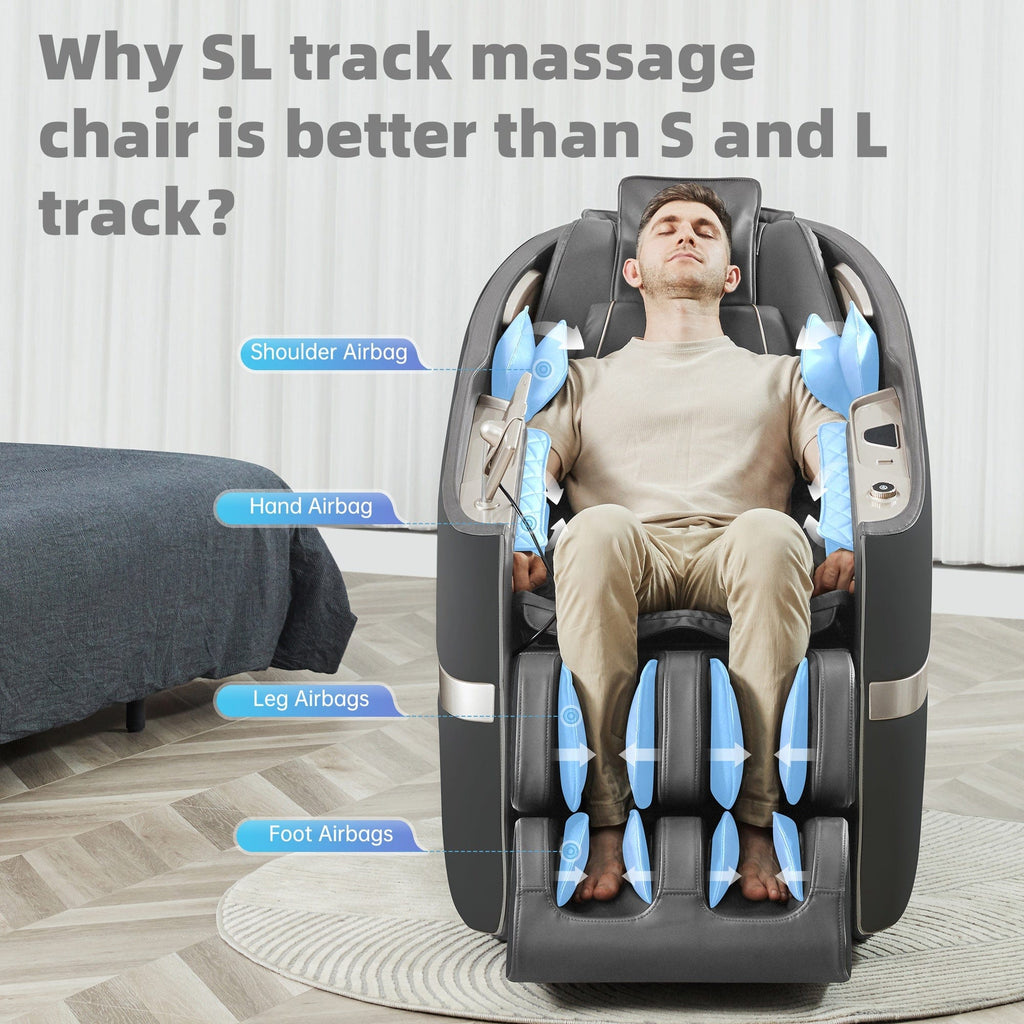
Air compression can complement either track style by gently holding or compressing the shoulders, arms, hips, calves, and feet. In an S-track chair, hip and glute airbags may help provide attention below the lower back even though rollers do not extend there.
Heat can add a warming sensation, usually around the lower back or seat, but it does not make a track more effective. Stretching programs use coordinated airbags and recline movement to change body position gradually. They should feel controlled rather than forceful. If you have an injury, recent surgery, circulation concerns, pregnancy, or a condition that affects sensation or movement, consult an appropriate healthcare professional before using intensive massage or stretching functions.
Who Should Choose an S-Track Chair?
An S-track massage chair is often the sensible choice when your main priority is focused massage along the back. It can deliver the contour-following roller path many people want without adding a long roller assembly beneath the thighs.
An S-track may suit you if:
- You mainly want relief-oriented comfort for the neck, shoulders, mid-back, and lumbar area.
- You prefer a massage that concentrates on the spine and surrounding back muscles.
- You are sensitive to direct roller pressure through the glutes.
- You value a potentially simpler seating feel when the massage is off.
- You do not consider upper-hamstring roller massage a must-have feature.
It is also worth considering an S-track if the chair has excellent adjustment options, a good body scan, and strong air compression. Those features may provide a more satisfying experience than a poorly fitted L-track with limited controls.
Credit: emassagechair.com
Who Should Choose an L-Track Chair?
An L-track chair is usually the better match for buyers who want the widest possible roller path in one chair. Its extended coverage can make a full program feel more comprehensive, especially for users who spend long periods seated or who simply enjoy massage through the hips and upper legs.
An L-track may suit you if:
- You want rollers to reach beyond the lower back into the glutes.
- You enjoy firm lower-body massage and want upper-hamstring coverage.
- You want a continuous massage route from the shoulders through the seat.
- You use full-body programs more often than short, targeted back sessions.
- You are comfortable with a seat design that may feel more active beneath you.
Choose carefully if you are especially pressure-sensitive. The ability to reduce roller intensity, select upper-body-only programs, or deactivate certain functions can make an L-track much more versatile.
Common Buying Mistakes to Avoid
Choosing by Track Name Alone
S-track and L-track descriptions are useful starting points, not complete quality ratings. A chair with a longer track may still have weak shoulder coverage, limited adjustments, an uncomfortable headrest, or poor legrest fit.
Assuming Every L-Track Has the Same Reach
Manufacturers may describe roller length differently, and the usable massage path can vary with chair design and body position. Review the stated coverage area and product diagrams rather than assuming all L-track chairs reach equally far down the thighs.
Ignoring the Chair’s Dimensions and Room Clearance
Massage chairs are large, especially when fully reclined. Measure the intended space, doorway widths, hallways, and delivery path. If the chair reclines backward rather than sliding forward, it may require substantial wall clearance.
Overlooking the Resting Seat Experience
If you plan to use the chair as regular seating, sit comfort matters even when the massage is off. An L-track’s under-seat components can change the cushion feel. Look for information about seat padding, the shape of the hip area, and whether the chair can be used comfortably without running a program.
Expecting a Massage Chair to Replace Medical Care
A massage chair can support relaxation and provide temporary comfort for ordinary muscle tension, but it is not a diagnostic tool or medical treatment. Persistent, severe, sudden, or worsening pain should be assessed by a qualified healthcare professional.
How to Compare Specific Massage Chair Models
Once you know whether you prefer an S-track or L-track, compare individual chairs using practical criteria. This approach is more useful than treating track style as the final decision.
- Confirm the real roller coverage. Find out where the rollers begin and end, especially below the lumbar area.
- Check fit guidance. Compare recommended height range, shoulder space, seat width, and legrest accommodation with the intended user.
- Review control options. Prioritize adjustable intensity, manual positioning, zone selection, and easy-to-use controls.
- Assess recline and room needs. Verify the chair’s dimensions upright and reclined, plus wall clearance requirements.
- Look at lower-body functions separately. Check whether calves and feet receive airbags, rollers, vibration, or a combination.
- Consider maintenance and support. Review warranty terms, service availability, upholstery care requirements, and replacement-part support.
For many buyers, the best decision is not “S-track versus L-track” in isolation. It is choosing the chair whose coverage, intensity, seating position, and body fit match how you expect to use it.
Credit: realrelaxmall.com
Frequently Asked Questions
Is an L-track always more expensive than an S-track?
Not always. L-track construction can appear more often in feature-rich chairs, but pricing also reflects the roller mechanism, upholstery, airbags, controls, recline system, warranty, and brand support. Compare the complete feature set rather than using track type as a price guide.
Can an S-track chair still massage the hips?
Yes. Many S-track chairs use airbags around the hips or seat, and some include vibration or heat in that area. The difference is that these features do not replicate the moving roller massage an L-track can provide beneath the seat.
Will a longer track work better for a tall person?
Not necessarily. A tall user also needs correct shoulder positioning, sufficient seat depth, a suitable headrest, and a legrest that can accommodate longer legs. Check the manufacturer’s height guidance and adjustment range before relying on track length alone.
Do massage chair rollers reach the calves and feet?
Main back rollers typically do not reach the calves or feet, even in an L-track chair. Those areas are usually addressed by calf airbags, foot rollers, foot airbags, or vibration systems located in the ottoman or legrest.
Which track is better for everyday relaxation?
Either can work well. Choose an S-track if a comfortable, back-focused massage is your priority. Choose an L-track if relaxation for you includes roller massage through the glutes and upper hamstrings. In both cases, adjustable intensity and proper body fit are more important than track style alone.