
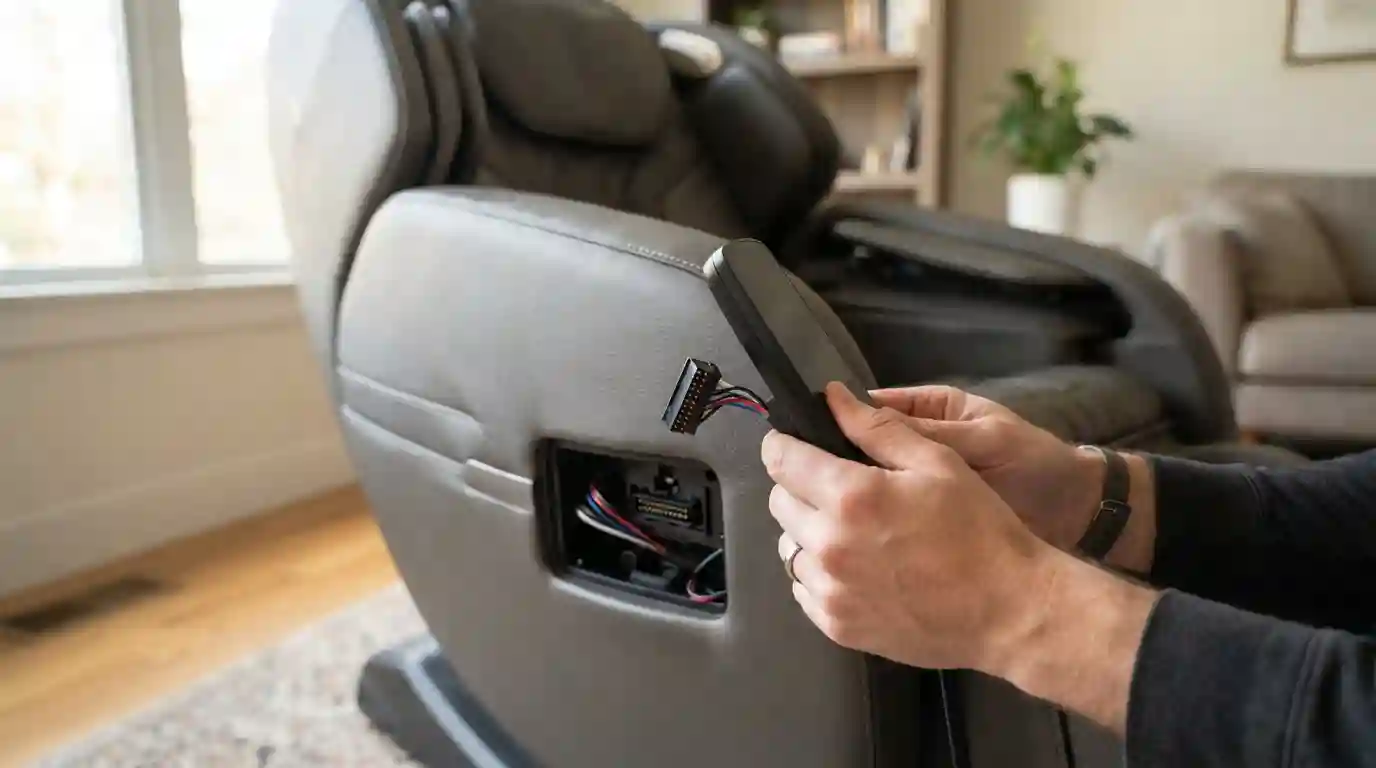
Finding the right Osaki massage chair replacement parts is less about matching the chair’s color or general shape and more about matching its exact model, production version, and electrical connections. Two chairs with similar names can use different remotes, control boards, air pumps, rollers, or wiring harnesses.
Some parts are practical for an owner to replace, especially detachable accessories and externally accessible components. Others involve high-voltage power, moving mechanisms, calibrated sensors, or tightly routed wiring. In those cases, using an incorrect part—or installing a correct part incorrectly—can create a larger and more expensive problem.
This guide explains which parts commonly fail, how to confirm compatibility before buying, and when a repair is realistic versus when professional service is the safer choice.
Why Massage Chair Parts Must Match the Exact Model
Massage chairs are not built around a universal parts standard. An Osaki chair’s massage mechanism, air system, electronics, and user controls are designed to work together as one system. A replacement component must match not only the chair brand but also the specific model and, in some cases, its production revision.
For example, a hand controller may look nearly identical to another controller but use different button mapping, connector pins, communication signals, or software. Likewise, an air pump that physically fits may have the wrong pressure output, voltage, hose layout, or connector.
Information to collect before ordering
Gather as much identifying information as possible before contacting a seller, service provider, or manufacturer-supported parts source:
- The complete model name and model number from the chair label
- The serial number
- The purchase date or approximate manufacturing period
- Clear photos of the failed part, labels, plugs, and mounting points
- Any part number printed on the old component
- A photo of the chair’s main rating label
- A description of the fault, including when it occurs
The model and serial number are especially important because manufacturers may update a component during a product’s production life. A chair assembled later may use a revised board, harness, or controller that is not interchangeable with the earlier version.
Fit means more than physical size
A part can be the right size and still be incompatible. Before purchasing, confirm these details:
| Compatibility factor | Why it matters |
|---|---|
| Part number | The most reliable way to identify an exact replacement or approved substitute. |
| Electrical rating | Motors, pumps, transformers, and power components must use the correct voltage and output. |
| Connector type and pin layout | Plugs that appear similar may have different pin counts, orientation, or wiring assignments. |
| Software or board revision | Electronic controls may require a specific version to communicate with the chair’s other systems. |
| Mounting arrangement | Screw locations, brackets, hose ports, and cable routing affect safe installation. |
| Left/right or front/rear position | Arm airbag assemblies, speakers, and side panels may be position-specific. |
Parts That Commonly Wear Out or Fail
Massage chairs have mechanical, pneumatic, electronic, and upholstered components. Failures are not always caused by a defective part; a loose plug, pinched hose, worn wire, or blocked mechanism can produce similar symptoms. Diagnosis should come before ordering.
Remote controls and control panels
Handheld remotes, wired controllers, and arm-mounted control panels are common replacement items. They can fail from liquid exposure, repeated cable bending, dropped controllers, worn buttons, or damaged connectors.
A blank display does not automatically mean the remote is bad. First verify that the chair has power, the outlet works, the main switch is on, and the controller cable is fully seated. If the chair powers on but does not respond to commands, the issue could be the remote, its cable, a control board, or a communication connector.
Power cords, switches, and power modules
Power-related components may fail after a surge, damage to the cord, repeated strain at the connection point, or internal electrical faults. A chair that does not power on should not be treated as a simple cord problem until basic checks are complete.
- Inspect the cord for cuts, crushed areas, melted spots, or loose connections.
- Test the wall outlet with another known-working device.
- Check whether the chair’s main power switch has been turned off.
- Look for a reset button or fuse access only if the owner’s documentation identifies one.
Do not replace a fuse with one of a different rating, bypass a fuse, modify a plug, or use a damaged power cord. Internal power supplies and electrical boards should be handled by a qualified technician.
Air pumps, valves, hoses, and airbags
Air compression systems use pumps, valves, tubing, and air cells to inflate sections around the shoulders, arms, hips, legs, and feet. A loss of air massage in one location can result from a disconnected hose, leaking airbag, pinched line, stuck valve, or pump problem.
If only one arm or leg area fails to inflate, a localized hose or airbag issue is more likely than a complete pump failure. If no air zones inflate and the chair otherwise operates, the pump, valve block, power feed, or control system may need diagnosis.
Airbags and hose assemblies are model-specific because their shape, attachment tabs, port positions, and inflation sequence vary. Avoid forcing a hose onto a mismatched port or sealing a leak with an adhesive that could restrict airflow or damage the material.
Massage rollers, motors, and drive components
The massage mechanism contains motors, gears, tracks, belts, sensors, and roller assemblies. These parts move under load and can wear over time. Symptoms may include clicking, grinding, incomplete travel, uneven roller movement, or a massage module that stops in one position.
Mechanical repairs are among the most complex Osaki massage chair replacement parts jobs. Access often requires removing upholstery sections, covers, and internal panels. The mechanism may be heavy, spring-loaded, or difficult to realign. A sound that resembles a motor failure can also come from a worn gear, obstructed track, loose fastener, or position sensor.
Stop using the chair if rollers move erratically, bind, scrape, or repeatedly attempt to travel beyond their normal range. Continued operation can damage the mechanism or upholstery.
Recline actuators and footrest components
Powered recline and leg-extension systems typically use actuators, motors, linkages, limit switches, and harnesses. These components can fail because of overload, damaged wiring, worn gears, or obstruction under or behind the chair.
Before assuming an actuator has failed, check that the chair has enough clearance from the wall and that no object is trapped beneath the footrest or recline frame. A jammed mechanism can place unnecessary load on a motor or actuator.
Replacing an actuator requires careful support of the chair frame. Never work underneath an unsupported reclined chair, and never place hands near moving linkages while the chair is powered.
Heating pads, speakers, USB modules, and lighting
Comfort and convenience features can also need replacement. Heating elements may stop warming, speakers may lose sound, USB ports may become loose, and decorative lighting may fail. These repairs are usually less critical to the chair’s core massage function, but they may still require opening panels or disconnecting internal wiring.
Do not assume an accessory module is interchangeable simply because it has the same connector. Its power demand and control signal may differ between models.
Upholstery, zipper covers, and padding
Surface wear is common on high-use massage chairs, particularly at the headrest, seat, arm openings, footwells, and areas that flex during recline. Peeling, cracking, torn seams, flattened padding, and worn zipper covers may be repairable without replacing a major internal component.
When replacing upholstery pieces, confirm whether the item is a removable cover, a sewn-on panel, or an integrated airbag cover. Cleaning products should also be chosen carefully. Harsh solvents, bleach, abrasive cleaners, and oversaturation can damage synthetic upholstery and foam.
Diagnose the Problem Before Ordering Parts
A systematic check can prevent buying a part that does not solve the problem. Start with the simplest external causes, then move toward the chair’s internal systems.
- Unplug the chair and inspect it visually. Look for loose cords, damaged upholstery, trapped objects, pinched hoses, and obvious disconnected plugs in accessible areas.
- Record the symptoms. Note whether the chair powers on, which functions work, where the failure occurs, and whether there are unusual noises.
- Test one function at a time. Check recline, rollers, airbags, heat, footrest movement, and controls separately if the chair permits it.
- Check external connections. Reseat removable controller plugs and accessible connectors only while the chair is unplugged.
- Review the manual or service guidance. Some models provide specific reset or troubleshooting instructions.
- Contact an authorized or experienced service source when the cause is unclear. This is particularly important for board, motor, pump, and actuator faults.
Photos and a short video of the symptom can be useful when requesting support. A video can show whether a motor hums, whether rollers attempt to move, or whether the chair stops at a certain point. Avoid opening electrical compartments while recording or testing.
Credit: picclick.com
How to Buy Compatible Osaki Massage Chair Replacement Parts
The safest option is an exact original part or a replacement specifically confirmed for the chair’s model and serial range. If the original part is discontinued, ask whether there is an approved revised component, adapter harness, or updated assembly.
Credit: picclick.com
Questions to ask the parts seller
- Is this part confirmed for my exact model and serial number?
- Is it an original part, an approved replacement, or an unverified aftermarket item?
- Does the part include the necessary cable, bracket, hardware, hose, or connector?
- Is programming, calibration, or professional installation required?
- What is the return policy if the part does not match the confirmed application?
- Is the part new, refurbished, or removed from another chair?
Be cautious with listings that identify a part only as “fits Osaki massage chairs” without naming the exact models. That description is usually too broad for electronics, pumps, mechanisms, and controllers. Used parts may be appropriate in limited situations, but their condition, revision number, and remaining service life can be difficult to verify.
Do not choose by appearance alone
Online photos are useful for comparison but should not be the final confirmation. Different components may share the same housing shape while using different labels, connectors, or internal programming. Compare the old and new part numbers, plug configuration, wire colors where visible, mounting holes, and physical orientation.
If a replacement arrives with a different part number, do not assume it is wrong—but do confirm that it is an approved supersession before installation. Manufacturers sometimes replace an older part with a revised version, though the update may require additional hardware or a matching harness.
Replacement Jobs Owners Can Often Handle
Only attempt a repair that you can complete without forcing components, working near exposed power circuitry, or disassembling the chair’s main mechanical structure. Always unplug the chair first and wait for all movement to stop.
Lower-risk replacement tasks
Depending on the model and access design, these may be reasonable owner-level tasks:
- Replacing a removable head pillow or headrest pad
- Replacing a detachable remote holder or accessory pocket
- Installing a confirmed compatible removable controller
- Replacing a removable exterior cushion or zipper cover
- Reseating an accessible, clearly identified low-voltage connector
- Replacing an externally detachable accessory where instructions are provided
Keep screws and clips organized by location. Take photos before disconnecting anything, route cables exactly as they were routed, and verify that no wire can be pinched by a moving arm, footrest, or recline frame.
A safe basic replacement process
- Turn the chair off and unplug it from the wall outlet.
- Move the chair to a clear, well-lit area with enough space to access the needed panel.
- Remove only the covers or fasteners required for the task.
- Photograph the original part, connectors, wire routing, and fastener positions.
- Disconnect the old part gently; do not pull on wires to remove a plug.
- Install the confirmed replacement without modifying connectors or enlarging mounting holes.
- Reinstall covers and check that all moving sections have clear travel.
- Reconnect power and test the repaired function while staying clear of moving mechanisms.
Repairs That Usually Need a Technician
Many massage chair repairs look straightforward until the chair is opened. Internal components can be difficult to access, and a mistake may affect more than one system. Professional service is strongly recommended for the following work:
- Main control boards, power boards, transformers, and internal fuses
- Massage roller motors, gearboxes, tracks, belts, and position sensors
- Recline actuators and structural linkage assemblies
- Air pumps, valve blocks, and complex internal hose routing
- Burning smells, smoke, overheating, sparking, or repeated power loss
- Any repair requiring work near exposed electrical terminals
A technician can identify whether a failed component is the cause or the result of another fault. For example, a new motor may fail quickly if the mechanism is binding, and a replacement control board may not solve a problem caused by a damaged harness.
Preventing Premature Part Failures
Regular care cannot prevent every failure, but it can reduce strain on moving, pneumatic, and upholstered parts. Follow the chair’s user guidance for body-size limits, operating time, placement, and cleaning.
- Leave sufficient space behind and around the chair for recline and footrest movement.
- Keep pets, toys, cords, and small objects away from the base and moving sections.
- Do not sit on the footrest, arm panels, or chair back unless the manufacturer specifically permits it.
- Use the chair on a stable, level surface.
- Keep liquids away from the remote, control panel, and seams.
- Clean upholstery with a soft cloth and suitable mild cleaner rather than harsh chemicals.
- Avoid repeatedly forcing a chair through a movement when it is making abnormal noise or stopping.
- Use appropriate surge protection only if it is compatible with the chair’s electrical requirements and local electrical standards.
When a fault begins, stop using the affected function and investigate early. A minor rubbing sound, air leak, or intermittent control issue is often easier to address before it damages related components.
Credit: massagechairstore.com
FAQ
Can I use a universal remote with an Osaki massage chair?
Usually not. Massage chair remotes often use model-specific wiring, control signals, and button programming. Use a remote confirmed for the exact chair model or an approved replacement identified by the supplier.
Where is the model number located on an Osaki massage chair?
The identification label is commonly placed on the back, side, underside, or lower rear area of the chair. Check the owner documentation as well. Record both the model number and serial number before requesting parts.
Is it worth repairing an older massage chair?
It depends on the fault, parts availability, labor cost, and overall condition of the chair. A replaceable remote, air hose, or upholstery component may be worthwhile, while major electronic or mechanical repairs can be less practical if multiple systems are worn or parts are discontinued.
Why does a replacement part fit physically but not work?
Physical fit does not confirm electrical or software compatibility. The part may have a different voltage requirement, connector pin layout, control protocol, or revision. Verify the part number and approved model application before installing it.
Should I keep using the chair if it makes a grinding noise?
No. Turn the chair off and unplug it if the noise comes from the rollers, recline system, footrest, or another moving mechanism. Continuing to operate it can worsen a mechanical fault and may damage connected parts.