
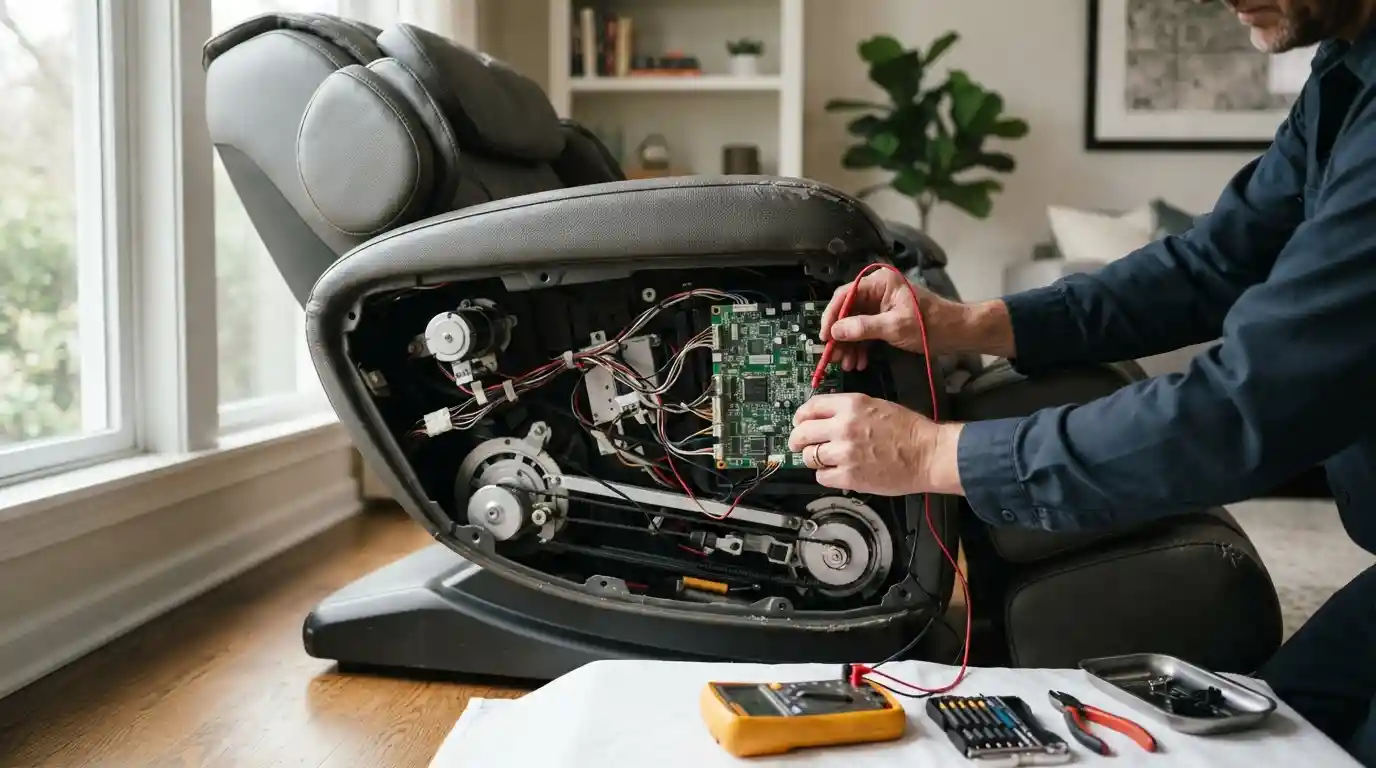
Massage chair repair usually starts with a simple question: is the problem caused by power, settings, a loose connection, or a failed mechanical part? Many issues that look serious—such as an unresponsive remote, a chair stuck in recline, or rollers that will not move—can sometimes be narrowed down with a few safe checks before arranging service.
At the same time, massage chairs combine electrical controls, motors, airbags, rollers, recline mechanisms, and often heat systems. That makes them more complex than ordinary recliners. A careful approach can help you avoid replacing the wrong part, causing further damage, or attempting a repair that should be left to a qualified technician.
This guide explains common massage chair problems, practical troubleshooting steps, likely repair cost factors, and when it makes more sense to call a professional.
Start With Safety Before You Repair a Massage Chair
Unplug the chair before inspecting cables, moving components by hand, removing covers, or checking anything beneath the seat. Do not work on the chair while it is connected to power, even if the chair appears switched off.
A massage chair may contain moving motors, capacitors, heating elements, and pinched wiring inside its frame. Stop using the chair and arrange professional service if you notice any of the following:
- A burning smell, smoke, sparks, or visible heat damage
- A repeatedly tripped circuit breaker or blown fuse
- Frayed, crushed, or exposed power wiring
- Water damage or liquid spilled into the chair
- Electrical shocks, tingling, or unusual vibration from the frame
- Loud grinding, metal-on-metal noise, or a recline mechanism that binds
Do not bypass a fuse, use an extension cord as a permanent solution, or force a stuck section of the chair. Forcing the footrest, backrest, rollers, or massage track can damage gears, cables, or the frame.
Common Massage Chair Problems and What They Usually Mean
The most useful first step in massage chair repair is identifying which system has failed. A chair that has power but will not recline needs a different diagnosis from a chair that reclines normally but has no massage movement.
| Problem | Possible Causes | Safe First Checks |
|---|---|---|
| Chair will not turn on | Loose plug, switched-off power button, tripped outlet, damaged power cord, internal power fault | Check outlet power, cord connection, main switch, and external fuse if the manual identifies one |
| Remote is blank or unresponsive | Loose handset cable, failed remote, software freeze, damaged connector | Inspect the cable and connector, then perform a power reset |
| Massage rollers do not move | Program setting, jammed track, motor issue, drive belt or gearbox problem, control-board fault | Try another program after resetting; listen for motor noise |
| Airbags will not inflate | Disconnected hose, leak, compressor fault, valve problem, program setting | Test another air-massage program and look for loose accessible hoses |
| Backrest or footrest will not recline | Obstruction, actuator failure, loose wiring, limit-switch issue, mechanical binding | Clear surrounding space, inspect for obstructions, and reset the chair |
| Heat does not work | Heat setting disabled, disconnected plug, failed heating pad, wiring or board fault | Confirm the selected program includes heat and allow time for gentle warming |
| Chair makes clicking, squealing, or grinding sounds | Loose fastener, debris, worn gears, dry pivot point, misaligned mechanism | Locate when the noise occurs; do not continue using it if movement is rough |
Chair Has No Power
If the chair appears completely dead, begin outside the chair rather than opening panels. Confirm that the wall outlet works by testing it with another suitable device. If the outlet is controlled by a wall switch, make sure the switch is on.
Check the power path
- Make sure the chair’s main power switch is in the on position. Some models have a switch near the lower rear frame in addition to the remote control.
- Push the power plug firmly into the wall outlet.
- Check whether the power cord connection at the chair has loosened, if the model uses a detachable cord.
- Inspect the visible cord for pinching, cuts, flattening, or heat damage.
- Check the outlet’s circuit breaker or ground-fault outlet reset if applicable.
Some chairs have a user-accessible fuse near the power input. Only inspect or replace it if the owner’s manual specifically identifies the correct fuse type and rating. Never substitute a different fuse rating, and never use foil or another object in place of a fuse.
If the chair has power indicators but the remote remains dark, the issue may be the remote cable, handset, transformer, or control board rather than the household outlet.
How to Reset a Massage Chair Safely
A reset can clear a temporary control error after a power interruption, an interrupted massage program, or a remote that has stopped responding. It will not repair a broken motor, torn air hose, stripped gear, or failed circuit board, but it is a sensible first step when the chair seems frozen.
The exact procedure varies by brand and model, so use the owner’s manual if it provides model-specific instructions. A general power reset is often performed as follows:
- Turn the chair off using its main power switch.
- Unplug it from the wall outlet.
- Wait several minutes so residual power can discharge.
- While the chair is unplugged, check that the remote cable and visible connectors are seated securely.
- Plug the chair directly into a working wall outlet.
- Turn on the main power switch and wait for the chair to complete any startup or return-to-home movement.
- Test a basic automatic program before changing multiple settings.
When people search for how to reset a massage chair, they may also mean returning the backrest and footrest to their upright positions. Many models include a “home,” “restore,” or “zero gravity return” control, but the label and behavior vary. Avoid manually pushing the chair closed while the motor is operating.
When a reset is unlikely to help
Repeated resets are not a solution if the chair trips a breaker, makes harsh mechanical noises, stops in the same position every time, or displays a persistent error code. Record the error code, when it appears, and which function triggers it. That information can help a service provider diagnose the fault without guesswork.
Massage Rollers Are Stuck, Weak, or Not Moving
The roller system is one of the more complex parts of a massage chair. Depending on the design, the rollers may travel along a track, change width, extend toward the user, or combine with a stretching motion. A problem can come from the program settings, roller carriage, drive motor, belt, gearbox, position sensor, wiring, or control board.
Credit: smartchoicerepaircenter.com
Check whether it is a setting issue
Before assuming the rollers have failed, test more than one massage program. Some programs focus on a limited area, use air compression more heavily, or keep rollers in a fixed position. Also check roller position, width, intensity, and body-scan settings if the remote provides those controls.
If the chair performs a body scan but then stops before massage begins, it may be detecting an obstruction, losing position feedback, or failing during the motor load phase. If the rollers move in one direction but not the other, a drive or sensor issue becomes more likely.
Listen without opening the mechanism
A humming motor with no roller movement can indicate a jammed carriage, worn drive component, or gearbox problem. Silence during a roller command may point to a disconnected wire, failed motor, control issue, or safety interlock. These clues are useful, but they are not enough to confirm a part replacement.
Do not lubricate the roller track with household oils, sprays, or grease unless the manufacturer specifically instructs you to do so. The wrong lubricant can attract dust, affect plastic parts, stain upholstery, or interfere with belts and sensors.
Airbags Do Not Inflate or Deflate Properly
Air-massage systems use a compressor or pump, valves, hoses, and air cells located around the shoulders, arms, hips, calves, or feet. A single failed zone does not always mean the entire system has failed.
First, select a program known to use air compression and increase air intensity if that adjustment is available. Then listen for the pump. If you can hear pumping but one area remains flat, the problem may be a loose hose, split line, leaking airbag, or valve issue. If no zones inflate and the pump is silent, the fault may be electrical or related to the compressor itself.
What you can inspect
With the chair unplugged, inspect only hoses and connections that are clearly accessible without dismantling the chair. Look for a hose that has slipped off a fitting, become kinked, or been crushed by a moving section. Reconnecting an obvious loose hose can be a reasonable repair massage chair task for a careful owner.
Do not pull aggressively on hoses hidden behind upholstery or inside the leg unit. Accessing valves, compressors, and internal air cells often requires partial disassembly and careful routing during reassembly. Incorrect hose routing can cause pinching when the chair reclines.
Recliner, Footrest, or Leg Extension Problems
A chair that will not recline or extend may have an obstruction, a failed actuator, a damaged cable, a position sensor issue, or a mechanical problem in the linkage. Start by moving objects away from the rear and front of the chair. Massage chairs need more clearance than standard recliners, especially when they slide forward or use a zero-gravity position.
Check for trapped rugs, toys, cables, loose clothing, or a footrest pressed against a wall. If an obstruction caused the chair to stop, reset it and test the movement with nobody sitting in it. Never reach beneath a powered chair while it is moving.
Signs of an actuator or linkage fault
- The chair clicks but does not move.
- The backrest moves unevenly or twists to one side.
- The footrest extends but will not retract.
- The motor runs continuously without changing the chair position.
- Movement stops at the same point even after the area is cleared.
These symptoms commonly need professional assessment. Recline components carry substantial load, and an incorrect repair can create a pinch hazard or damage the frame.
Remote Control, Display, and Control Panel Faults
An unresponsive remote does not automatically mean the remote itself is defective. Many handsets are connected through a cable that can loosen near the armrest, under the seat, or at a control box. With the chair unplugged, check accessible connections for a fully seated plug, bent pins, visible corrosion, or cable damage.
Do not force a connector into place. If it will not fit easily, check its orientation. For wireless remotes, replace batteries only with the type specified by the manufacturer and inspect the battery compartment for leakage or corrosion.
If the screen lights up but buttons do not work, a reset may help. If only certain functions fail, note which ones. For example, a working remote combined with nonfunctional heat may indicate a different fault from a completely blank remote display.
Credit: massagechairheaven.com
Heat, Speakers, USB Ports, and Other Secondary Features
Secondary features can fail independently of the core massage system. A chair may still massage normally even if its heat, speakers, USB charging port, or Bluetooth connection does not work.
For heat, confirm that the selected massage mode includes heat and that its setting is enabled. Heating pads are designed for mild warmth rather than the intense heat of a heating blanket, so give the chair time to warm. If there is no warmth at all after proper setup, discontinue troubleshooting if you smell overheating or see damage.
USB and audio issues may be caused by the user’s cable, device settings, pairing process, or a failed accessory module. Test with another compatible cable or device before assuming the chair needs an internal repair. Avoid charging devices through a damaged port.
What Massage Chair Repair Costs Depend On
The cost to fix a massage chair depends less on the symptom alone and more on the failed component, chair design, parts availability, and labor required to reach the part. A remote replacement is typically simpler and less labor-intensive than replacing an internal recline actuator, roller motor, compressor, or control board.
Rather than relying on a generic price estimate, ask for a written diagnosis and quote that separates the likely cost categories:
- Service call or diagnostic work: Travel time and fault finding, especially for in-home service.
- Replacement part: The specific component, such as a handset, motor, pump, hose, actuator, power supply, or circuit board.
- Labor: Time needed for disassembly, installation, adjustment, and testing.
- Shipping: Larger or model-specific parts may be costly to transport.
- Warranty coverage: Parts, labor, and in-home service may have different warranty periods.
Why access can matter as much as the part
Many faults are hidden behind upholstery, molded covers, or tightly packed mechanisms. A relatively inexpensive part can become a more expensive repair if the technician must remove the leg unit, side panels, seat cushions, or roller assembly to reach it. Conversely, an external power cord or readily accessible air hose may be quick to resolve.
When repair may not be economical
Consider the chair’s age, overall condition, availability of parts, and the number of unrelated issues. If a chair has a major electronic failure along with worn upholstery, noisy mechanics, and recurring air-system problems, a repair quote may approach the practical value of replacing it.
That does not mean replacement is always the better choice. A well-built chair with a single identifiable fault can be worth repairing, particularly when the manufacturer still supports the model and the frame, upholstery, and other functions remain in good condition.
DIY Repairs That Are Usually Reasonable
Owners can often handle basic checks and a limited range of low-risk tasks, provided they follow the manual and keep the chair unplugged. These tasks do not require opening electrical housings or disassembling load-bearing mechanisms.
- Checking the outlet, plug, power switch, and visible power cord
- Performing a manufacturer-approved power reset
- Removing objects that block the recline or footrest path
- Securing a clearly accessible, loose connector
- Replacing remote batteries when applicable
- Cleaning the exterior and vacuuming debris from accessible gaps
- Checking accessible air hoses for obvious kinks or disconnections
- Ordering an approved replacement remote or power cord for the exact model
Before ordering a part, verify the full model number from the chair’s label. Similar-looking chairs can use different remotes, connectors, control boards, actuators, and power supplies.
Repairs Better Left to a Technician
Professional massage chair repair is the safer option for internal electrical work, moving mechanisms, major upholstery removal, and faults that require diagnosis tools or manufacturer documentation.
- Replacing motors, gearboxes, roller assemblies, or drive belts
- Replacing recline actuators or repairing structural linkages
- Repairing power supplies, circuit boards, fuses that repeatedly fail, or internal wiring
- Diagnosing persistent error codes
- Repairing heating elements or thermal controls
- Replacing compressors, valves, hidden air hoses, or internal airbags
- Addressing damage caused by liquid, pests, impact, or overheating
Use the manufacturer’s service network when available, especially for a chair under warranty. An unauthorized repair may affect warranty coverage, and official technicians may have access to model-specific part numbers, diagnostic procedures, and updated service information.
How to Prepare for a Service Visit
A clear description of the problem can reduce unnecessary diagnostic time. Before booking service, collect the chair’s model number, purchase information if available, and any error message shown on the remote.
It also helps to document:
- When the problem began and whether it followed a power outage, move, spill, or unusual noise
- Which functions still work and which do not
- Whether the failure happens every time or only in certain programs
- Whether you hear clicking, humming, pumping, grinding, or no sound at all
- Whether the chair is stuck upright, reclined, or with the footrest extended
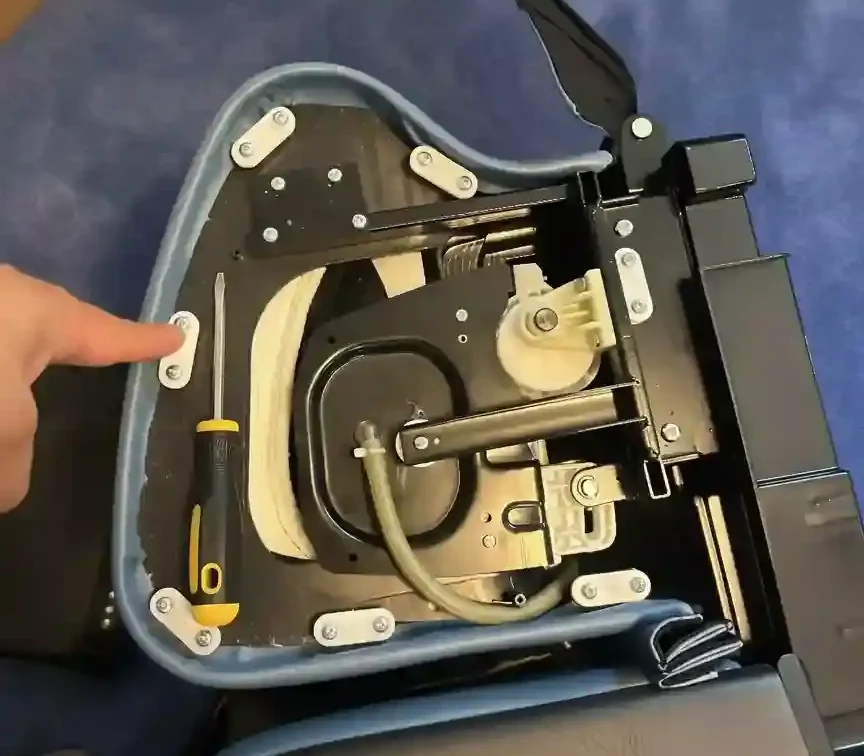
Clear space around the chair before the appointment. Technicians may need access to the rear, sides, and underside, and a heavy chair may require more than one person to reposition safely.
Credit: ergosetupboston.com
Preventing Future Problems
Regular care cannot prevent every component failure, but it can reduce strain on the chair. Keep adequate wall clearance, avoid placing the chair on uneven flooring, and do not exceed the manufacturer’s user-weight guidance. Keep pets, children, cords, and objects away from moving sections during operation.
Use a dry, soft cloth for routine surface cleaning unless the manufacturer recommends a specific upholstery cleaner. Avoid spraying cleaner directly into seams, controls, speakers, or remote openings. If the chair will not be used for an extended period, follow the manufacturer’s storage guidance and protect it from dampness, extreme temperatures, and direct sunlight.
Frequently Asked Questions
Can I use a surge protector with a massage chair?
Only if the chair manufacturer permits it and the surge protector is suitable for the chair’s electrical load. Some manufacturers recommend plugging directly into a properly grounded wall outlet. Check the owner’s manual before adding an extension lead, surge protector, or smart plug.
Why does my massage chair work for a few minutes and then stop?
The chair may be entering a timed program end, overheating protection mode, or fault condition. Let it cool, reset it once, and try a different program. If it repeatedly stops before the program ends, service may be needed.
Can a torn massage chair upholstery cover be repaired?
Small cosmetic damage may be repairable by an upholstery specialist, but tears near moving airbags, roller tracks, or wiring need careful assessment. A patch that interferes with movement or airflow can create additional problems.
Should I move a massage chair on its side?
Follow the manufacturer’s moving instructions. Many massage chairs are heavy and contain components that can shift or be damaged if handled incorrectly. Use enough helpers, protect the remote and leg unit, and avoid lifting by armrests, footrests, or removable cushions.
How long should I keep trying to troubleshoot before calling for repair?
After basic power checks, a reset, and an inspection for obvious obstructions or loose accessible connections, stop if the issue persists. Call for service immediately for electrical symptoms, overheating, repeated breaker trips, grinding noises, or unsafe recline movement.
Sources & References
Repair procedures, electrical requirements and replacement parts vary by model. Follow the exact manufacturer manual and use qualified service for internal electrical or load-bearing repairs.
4 thoughts on “Massage Chair Repair: Common Problems, Costs and Practical Fixes”